


Page 222 - Berkshire Encyclopedia Of World History Vol I - Abraham to Coal
P. 222
archaeology 107


            Imaginable?  Despite its summit fiasco, the Arab world is groping for  century CE, for example, Cyriacus of Ancona, an Italian
              democracy. (2004, April 3). The Economist, 371(8369), 13.  merchant, traveled the Mediterranean coast and Greece,
            UN: Lack of freedom stunts Arab nations. (2002, July 2). USA Today,
              p. 6A.                                            drawing and gathering information about ancient mon-
                                                                uments, copying inscriptions, and collecting objects from
                                                                early civilizations. Because Cyriacus attempted to study
                                                                ancient writings and material culture, some consider
                                                                him to be one of the  first archaeologists. Moreover,
                           Archaeology                          scholars began to challenge religious traditions through
                                                                archaeology. For instance, in 1655, Isaac de la Peyrere
                rchaeology is a part of the anthropological four-field  argued that stone tools found in Europe came from a
            Aapproach to studying past and present cultures.The  culture that existed before the biblical Adam.The devel-
            biological, linguistic, sociocultural, and archaeological  opment of Assyriology and Egyptology during the nine-
            divisions of anthropology work together to research soci-  teenth century  CE also contributed to how scholars
            eties through areas such as diet, language, social struc-  studied the civilizations of Assyria, Egypt, and others.
            tures, and kinships.Archaeology in particular attempts to  Jean Francois Champollion’s deciphering of the Rosetta
            understand, describe, and explain the construction and  stone in 1822 was a huge breakthrough in understand-
            development of past cultures through the study of their  ing ancient Egyptian languages and dialects.
            material remains. In order to do this, archaeologists  Also during the nineteenth century, scholars and
            often incorporate interdisciplinary methodologies from  laypersons from Europe and other countries around the
            other fields, as well as develop techniques to explore the  world sought to explore past civilizations through the
            numerous questions archaeological data may present.  study of material culture. Although most had sincere
              It appears that people have always had an interest in  motives, some of the approaches to excavating were
            groups that lived before them. Typically, most want to  essentially treasure hunting. However, the growing study
            understand how previous cultures interpreted the world  of evolution during this period influenced archaeology
            around them. For instance, during Egypt’s eighteenth  profoundly. Many scholars now began to investigate the
            dynasty (1532–1305 BCE), a number of scribes wanted
            to know more about how those that lived before them
            constructed tombs, how people were interred, and how
            they interpreted the afterlife. To answer these questions
            they examined burials dating from centuries earlier and
            left graffiti to record their visits. During the sixth century
            BCE Nabonidus, a prominent king of the famous Baby-
            lonian empire, demonstrated his interest in the past by
            excavating at the city of Ur. He desired to know more
            about ancient Sumerian culture, a civilization then
            already 2,500 years old. Interestingly, the Babylonian
            king shared many of his finds with others by exhibiting
            them. His daughter, Bel-Shalti Nannar, continued her
            father’s archaeological work following his death.
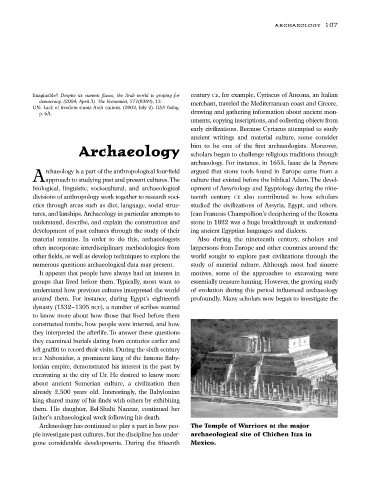
              Archaeology has continued to play a part in how peo-  The Temple of Warriors at the major
            ple investigate past cultures, but the discipline has under-  archaeological site of Chichen Itza in
            gone considerable developments. During the  fifteenth  Mexico.

