


Page 224 - Berkshire Encyclopedia Of World History Vol I - Abraham to Coal
P. 224
architecture 109


            group of buildings. However, the  field overlaps with
            interior design and with landscape and urban design.
            Architects respond to the socioeconomic and cultural
            contexts in which they are practicing. Many architects
            agree with the ancient Roman Vitruvius (c. 90 BCE–c. 20
            BCE ), who wrote that architecture must be stable, useful,
            and beautiful.To accomplish this architects must under-
            stand (a) how to employ one or more structural systems
            to support the design, (b) how the design will be used
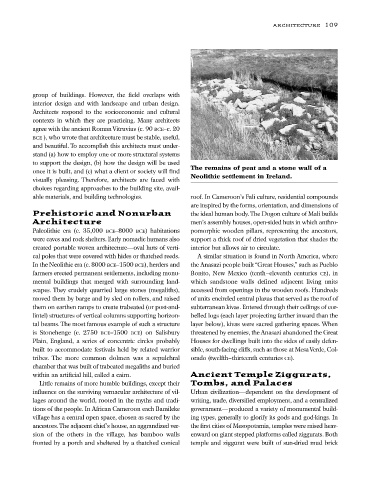
                                                                The remains of peat and a stone wall of a
            once it is built, and (c) what a client or society will find
                                                                Neolithic settlement in Ireland.
            visually pleasing. Therefore, architects are faced with
            choices regarding approaches to the building site, avail-
            able materials, and building technologies.          roof. In Cameroon’s Fali culture, residential compounds
                                                                are inspired by the forms, orientation, and dimensions of
            Prehistoric and Nonurban                            the ideal human body.The Dogon culture of Mali builds
            Architecture                                        men’s assembly houses, open-sided huts in which anthro-
            Paleolithic era (c. 35,000  BCE–8000  BCE) habitations  pomorphic wooden pillars, representing the ancestors,
            were caves and rock shelters. Early nomadic humans also  support a thick roof of dried vegetation that shades the
            created portable woven architecture—oval huts of verti-  interior but allows air to circulate.
            cal poles that were covered with hides or thatched reeds.  A similar situation is found in North America, where
            In the Neolithic era (c. 8000 BCE–1500 BCE), herders and  the Anasazi people built “Great Houses,” such as Pueblo
            farmers erected permanent settlements, including monu-  Bonito, New Mexico (tenth–eleventh centuries  CE), in
            mental buildings that merged with surrounding land-  which sandstone walls defined adjacent living units
            scapes. They crudely quarried large stones (megaliths),  accessed from openings in the wooden roofs. Hundreds
            moved them by barge and by sled on rollers, and raised  of units encircled central plazas that served as the roof of
            them on earthen ramps to create trabeated (or post-and-  subterranean kivas. Entered through their ceilings of cor-
            lintel) structures of vertical columns supporting horizon-  belled logs (each layer projecting farther inward than the
            tal beams.The most famous example of such a structure  layer below), kivas were sacred gathering spaces. When
            is Stonehenge (c. 2750  BCE–1500  BCE) on Salisbury  threatened by enemies, the Anasazi abandoned the Great
            Plain, England, a series of concentric circles probably  Houses for dwellings built into the sides of easily defen-
            built to accommodate festivals held by related warrior  sible, south-facing cliffs, such as those at Mesa Verde, Col-
            tribes. The more common dolmen was a sepulchral     orado (twelfth–thirteenth centuries CE).
            chamber that was built of trabeated megaliths and buried
            within an artificial hill, called a cairn.           Ancient Temple Ziggurats,
              Little remains of more humble buildings, except their  Tombs, and Palaces
            influence on the surviving vernacular architecture of vil-  Urban civilization—dependent on the development of
            lages around the world, rooted in the myths and tradi-  writing, trade, diversified employment, and a centralized
            tions of the people. In African Cameroon each Bamileke  government—produced a variety of monumental build-
            village has a central open space, chosen as sacred by the  ing types, generally to glorify its gods and god-kings. In
            ancestors.The adjacent chief’s house, an aggrandized ver-  the first cities of Mesopotamia, temples were raised heav-
            sion of the others in the village, has bamboo walls  enward on giant stepped platforms called ziggurats. Both
            fronted by a porch and sheltered by a thatched conical  temple and ziggurat were built of sun-dried mud brick

