


Page 223 - Berkshire Encyclopedia Of World History Vol I - Abraham to Coal
P. 223
108 berkshire encyclopedia of world history


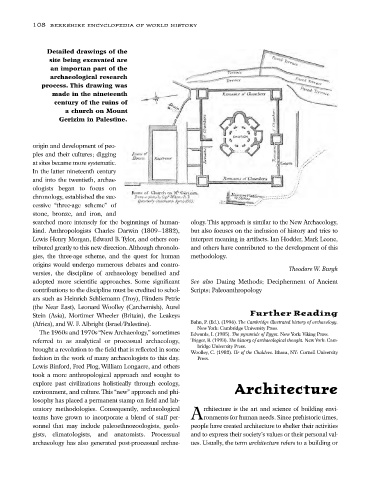
                 Detailed drawings of the
                 site being excavated are
                  an importan part of the
                  archaeological research
               process. This drawing was
                  made in the nineteenth
                   century of the ruins of
                       a church on Mount
                     Gerizim in Palestine.


            origin and development of peo-
            ples and their cultures; digging
            at sites became more systematic.
            In the latter nineteenth century
            and into the twentieth, archae-
            ologists began to focus on
            chronology, established the suc-
            cessive  “three-age scheme” of
            stone, bronze, and iron, and
            searched more intensely for the beginnings of human-  ology.This approach is similar to the New Archaeology,
            kind. Anthropologists Charles Darwin (1809–1882),   but also focuses on the inclusion of history and tries to
            Lewis Henry Morgan, Edward B. Tylor, and others con-  interpret meaning in artifacts. Ian Hodder, Mark Leone,
            tributed greatly to this new direction.Although chronolo-  and others have contributed to the development of this
            gies, the three-age scheme, and the quest for human  methodology.
            origins would undergo numerous debates and contro-
                                                                                                Theodore W. Burgh
            versies, the discipline of archaeology benefited and
            adopted more scientific approaches. Some significant  See also Dating Methods; Decipherment of  Ancient
            contributions to the discipline must be credited to schol-  Scripts; Paleoanthropology
            ars such as Heinrich Schliemann (Troy), Flinders Petrie
            (the Near East), Leonard Woolley (Carchemish), Aurel
            Stein (Asia), Mortimer Wheeler (Britain), the Leakeys                   Further Reading
            (Africa), and W. F. Albright (Israel/Palestine).    Bahn, P. (Ed.). (1996). The Cambridge illustrated history of archaeology.
                                                                  New York: Cambridge University Press.
              The 1960s and 1970s “New Archaeology,” sometimes  Edwards, I. (1985). The pyramids of Egypt. New York: Viking Press.
            referred to as analytical or processual archaeology,  Trigger, B. (1993). The history of archaeological thought. New York: Cam-
                                                                  bridge University Press.
            brought a revolution to the field that is reflected in some
                                                                Woolley, C. (1982). Ur of the Chaldees. Ithaca, NY: Cornell University
            fashion in the work of many archaeologists to this day.  Press.
            Lewis Binford, Fred Plog,William Longacre, and others
            took a more anthropological approach and sought to
            explore past civilizations holistically through ecology,
            environment, and culture.This “new” approach and phi-              Architecture
            losophy has placed a permanent stamp on field and lab-
            oratory methodologies. Consequently, archaeological     rchitecture is the art and science of building envi-
            teams have grown to incorporate a blend of staff per- Aronments for human needs. Since prehistoric times,
            sonnel that may include paleoethnozoologists, geolo-  people have created architecture to shelter their activities
            gists, climatologists, and anatomists. Processual   and to express their society’s values or their personal val-
            archaeology has also generated post-processual archae-  ues. Usually, the term architecture refers to a building or

