


Page 226 - Berkshire Encyclopedia Of World History Vol I - Abraham to Coal
P. 226
architecture 111


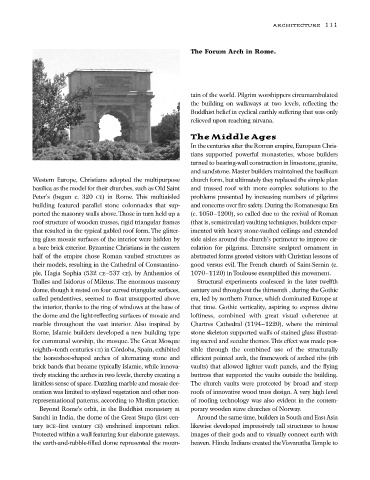
                                                                The Forum Arch in Rome.


                                                                tain of the world. Pilgrim worshippers circumambulated
                                                                the building on walkways at two levels, reflecting the
                                                                Buddhist belief in cyclical earthly suffering that was only
                                                                relieved upon reaching nirvana.


                                                                The Middle Ages
                                                                In the centuries after the Roman empire, European Chris-
                                                                tians supported powerful monasteries, whose builders
                                                                turned to bearing-wall construction in limestone, granite,
                                                                and sandstone. Master builders maintained the basilican
            Western Europe, Christians adopted the multipurpose  church form, but ultimately they replaced the simple plan
            basilica as the model for their churches, such as Old Saint  and trussed roof with more complex solutions to the
            Peter’s (begun c. 320 CE) in Rome. This multiaisled  problems presented by increasing numbers of pilgrims
            building featured parallel stone colonnades that sup-  and concerns over fire safety.During the Romanesque Era
            ported the masonry walls above.Those in turn held up a  (c. 1050–1200), so called due to the revival of Roman
            roof structure of wooden trusses, rigid triangular frames  (that is, semicircular) vaulting techniques, builders exper-
            that resulted in the typical gabled roof form.The glitter-  imented with heavy stone-vaulted ceilings and extended
            ing glass mosaic surfaces of the interior were hidden by  side aisles around the church’s perimeter to improve cir-
            a bare brick exterior. Byzantine Christians in the eastern  culation for pilgrims. Extensive sculpted ornament in
            half of the empire chose Roman vaulted structures as  abstracted forms greeted visitors with Christian lessons of
            their models, resulting in the Cathedral of Constantino-  good versus evil. The French church of Saint-Sernin (c.
            ple, Hagia Sophia (532 CE–537 CE), by Anthemios of  1070–1120) in Toulouse exemplified this movement.
            Tralles and Isidorus of Miletus. The enormous masonry  Structural experiments coalesced in the later twelfth
            dome, though it rested on four curved triangular surfaces,  century and throughout the thirteenth , during the Gothic
            called pendentives, seemed to float unsupported above  era, led by northern France, which dominated Europe at
            the interior, thanks to the ring of windows at the base of  that time. Gothic verticality, aspiring to express divine
            the dome and the light-reflecting surfaces of mosaic and  loftiness, combined with great visual coherence at
            marble throughout the vast interior. Also inspired by  Chartres Cathedral (1194–1220), where the minimal
            Rome, Islamic builders developed a new building type  stone skeleton supported walls of stained glass illustrat-
            for communal worship, the mosque.The Great Mosque   ing sacred and secular themes.This effect was made pos-
            (eighth–tenth centuries CE)inCórdoba, Spain, exhibited  sible through the combined use of the structurally
            the horseshoe-shaped arches of alternating stone and  efficient pointed arch, the framework of arched ribs (rib
            brick bands that became typically Islamic, while innova-  vaults) that allowed lighter vault panels, and the flying
            tively stacking the arches in two levels, thereby creating a  buttress that supported the vaults outside the building.
            limitless sense of space. Dazzling marble and mosaic dec-  The church vaults were protected by broad and steep
            oration was limited to stylized vegetation and other non-  roofs of innovative wood truss design. A very high level
            representational patterns, according to Muslim practice.  of roofing technology was also evident in the contem-
              Beyond Rome’s orbit, in the Buddhist monastery at  porary wooden stave churches of Norway.
            Sanchi in India, the dome of the Great Stupa (first cen-  Around the same time, builders in South and East Asia
            tury  BCE–first century  CE) enshrined important relics.  likewise developed impressively tall structures to house
            Protected within a wall featuring four elaborate gateways,  images of their gods and to visually connect earth with
            the earth-and-rubble-filled dome represented the moun-  heaven. Hindu Indians created theVisvanatha Temple to

