


Page 217 - Berkshire Encyclopedia Of World History Vol I - Abraham to Coal
P. 217
102 berkshire encyclopedia of world history


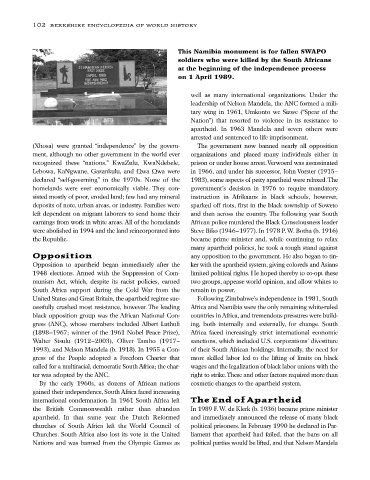
                                                            This Namibia monument is for fallen SWAPO
                                                            soldiers who were killed by the South Africans
                                                            at the beginning of the independence process
                                                            on 1 April 1989.


                                                                well as many international organizations. Under the
                                                                leadership of Nelson Mandela, the ANC formed a mili-
                                                                tary wing in 1961, Umkonto we Sizwe (“Spear of the
                                                                Nation”) that resorted to violence in its resistance to
                                                                apartheid. In 1963 Mandela and seven others were
                                                                arrested and sentenced to life imprisonment.
            (Xhosa) were granted  “independence” by the govern-   The government now banned nearly all opposition
            ment, although no other government in the world ever  organizations and placed many individuals either in
            recognized these  “nations.” KwaZulu, KwaNdebele,   prison or under house arrest.Verwoerd was assassinated
            Lebowa, KaNgwane, Gazankulu, and Qwa Qwa were       in 1966, and under his successor, John Vorster (1915–
            declared  “self-governing” in the 1970s. None of the  1983), some aspects of petty apartheid were relaxed.The
            homelands were ever economically viable. They con-  government’s decision in 1976 to require mandatory
            sisted mostly of poor, eroded land; few had any mineral  instruction in  Afrikaans in black schools, however,
            deposits of note, urban areas, or industry. Families were  sparked off riots, first in the black township of Soweto
            left dependent on migrant laborers to send home their  and then across the country. The following year South
            earnings from work in white areas. All of the homelands  African police murdered the Black Consciousness leader
            were abolished in 1994 and the land reincorporated into  Steve Biko (1946–1977). In 1978 P.W. Botha (b. 1916)
            the Republic.                                       became prime minister and, while continuing to relax
                                                                many apartheid policies, he took a tough stand against
            Opposition                                          any opposition to the government. He also began to tin-
            Opposition to apartheid began immediately after the  ker with the apartheid system, giving coloreds and Asians
            1948 elections. Armed with the Suppression of Com-  limited political rights. He hoped thereby to co-opt these
            munism Act, which, despite its racist policies, earned  two groups, appease world opinion, and allow whites to
            South  Africa support during the Cold War from the  remain in power.
            United States and Great Britain, the apartheid regime suc-  Following Zimbabwe’s independence in 1981, South
            cessfully crushed most resistance, however. The leading  Africa and Namibia were the only remaining white-ruled
            black opposition group was the African National Con-  countries in Africa, and tremendous pressures were build-
            gress (ANC), whose members included Albert Luthuli  ing, both internally and externally, for change. South
            (1898–1967; winner of the 1961 Nobel Peace Prize),  Africa faced increasingly strict international economic
            Walter Sisulu (1912–2003), Oliver Tambo  (1917–     sanctions, which included U.S. corporations’ divestiture
            1993), and Nelson Mandela (b. 1918). In 1955 a Con-  of their South African holdings. Internally, the need for
            gress of the People adopted a Freedom Charter that  more skilled labor led to the lifting of limits on black
            called for a multiracial, democratic South Africa; the char-  wages and the legalization of black labor unions with the
            ter was adopted by the ANC.                         right to strike.These and other factors required more than
              By the early 1960s, as dozens of  African nations  cosmetic changes to the apartheid system.
            gained their independence, South Africa faced increasing
            international condemnation. In 1961 South Africa left  The End of Apartheid
            the British Commonwealth rather than abandon        In 1989 F.W. de Klerk (b. 1936) became prime minister
            apartheid. In that same year the Dutch Reformed     and immediately announced the release of many black
            churches of South  Africa left the World Council of  political prisoners. In February 1990 he declared in Par-
            Churches. South Africa also lost its vote in the United  liament that apartheid had failed, that the bans on all
            Nations and was banned from the Olympic Games as    political parties would be lifted, and that Nelson Mandela

