


Page 216 - Berkshire Encyclopedia Of World History Vol I - Abraham to Coal
P. 216
apartheid in south africa 101


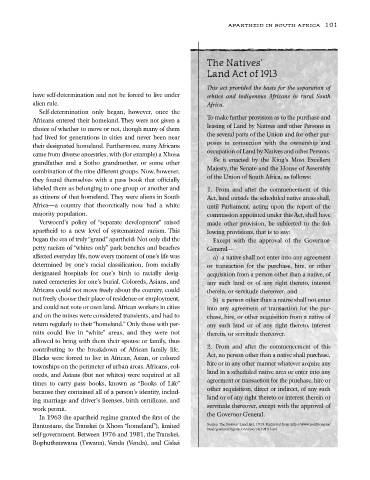
                                                                     The Natives’
                                                                     Land Act of 1913


                                                                     This act provided the basis for the separation of
            have self-determination and not be forced to live under  whites and indigenous Africans in rural South
            alien rule.                                              Africa.
              Self-determination only began, however, once the
                                                                     To make further provision as to the purchase and
            Africans entered their homeland. They were not given a
                                                                     leasing of Land by Natives and other Persons in
            choice of whether to move or not, though many of them
                                                                     the several parts of the Union and for other pur-
            had lived for generations in cities and never been near
                                                                     poses in connection with the ownership and
            their designated homeland. Furthermore, many Africans
                                                                     occupation of Land by Natives and other Persons.
            came from diverse ancestries, with (for example) a Xhosa
                                                                       Be it enacted by the King’s Most Excellent
            grandfather and a Sotho grandmother, or some other
                                                                     Majesty, the Senate and the House of Assembly
            combination of the nine different groups. Now, however,
                                                                     of the Union of South Africa, as follows:
            they found themselves with a pass book that officially
            labeled them as belonging to one group or another and    1. From and after the commencement of this
            as citizens of that homeland. They were aliens in South  Act, land outside the scheduled native areas shall,
            Africa—a country that theoretically now had a white      until Parliament, acting upon the report of the
            majority population.                                     commission appointed under this Act, shall have
              Verwoerd’s policy of “separate development” raised     made other provision, be subjected to the fol-
            apartheid to a new level of systematized racism. This    lowing provisions, that is to say:
            began the era of truly “grand” apartheid: Not only did the  Except with the approval of the Governor-
            petty racism of “whites only” park benches and beaches   General—
            affected everyday life, now every moment of one’s life was  a) a native shall not enter into any agreement
            determined by one’s racial classification, from racially  or transaction for the purchase, hire, or other
            designated hospitals for one’s birth to racially desig-  acquisition from a person other than a native, of
            nated cemeteries for one’s burial. Coloreds, Asians, and  any such land or of any right thereto, interest
            Africans could not move freely about the country, could  therein, or servitude thereover; and
            not freely choose their place of residence or employment,  b) a person other than a native shall not enter
            and could not vote or own land.African workers in cities  into any agreement or transaction for the pur-
            and on the mines were considered transients, and had to  chase, hire, or other acquisition from a native of
            return regularly to their “homeland.” Only those with per-  any such land or of any right thereto, interest
            mits could live in  “white” areas, and they were not     therein, or servitude thereover.
            allowed to bring with them their spouse or family, thus
                                                                     2. From and after the commencement of this
            contributing to the breakdown of  African family life.
                                                                     Act, no person other than a native shall purchase,
            Blacks were forced to live in African, Asian, or colored
                                                                     hire or in any other manner whatever acquire any
            townships on the perimeter of urban areas.Africans, col-
                                                                     land in a scheduled native area or enter into any
            oreds, and Asians (but not whites) were required at all
                                                                     agreement or transaction for the purchase, hire or
            times to carry pass books, known as “Books of Life”
                                                                     other acquisition, direct or indirect, of any such
            because they contained all of a person’s identity, includ-
                                                                     land or of any right thereto or interest therein or
            ing marriage and driver’s licenses, birth certificate, and
                                                                     servitude thereover, except with the approval of
            work permit.
                                                                     the Governor-General.
              In 1963 the apartheid regime granted the first of the
            Bantustans, the Transkei (a Xhosa “homeland”), limited   Source: The Natives’ Land Act, 1913. Retrieved from http://www.polity.org.za/
                                                                     html/govdocs/legislation/misc/nla1913.html
            self-government. Between 1976 and 1981, the Transkei,
            Bophuthatswana (Tswana), Venda (Venda), and Ciskei

