


Page 215 - Berkshire Encyclopedia Of World History Vol I - Abraham to Coal
P. 215
100 berkshire encyclopedia of world history


                                                   As I would not be a slave, so I would not be a master. This expresses my
                                                        idea of Democracy.Whatever differs from this, to the extent of the
                                                     difference, is no Democracy. • Abraham Lincoln (1809–1865)


            refers to the everyday examples of racial discrimination,  the government as a Communist; the Reservation of Sep-
            such as marriage restrictions and segregated facilities and  arate Amenities Act (1953); and the Bantu Education Act
            amenities, housing, jobs, transportation, and education.  (1953). This last denied government support to private
            During the first decade following the 1948 elections,  and church-run (often mission) schools and placed the
            apartheid policies developed in a rather crude manner  entire national education system under the government’s
            under the label of baaskap. This Afrikaans term roughly  direction, resulting in a significant decline in the quality
            translates as “mastery,” or white supremacy, with a very  of black education.
            explicit notion of a master (the “boss”) and servant rela-
            tionship between white and black.The Afrikaners’ obses-  The Baaskap Period and
            sion with cultural survival and almost pathological fear  Hendrik Verwoerd
            of the swart gevaar (“black peril”) resulted in a series of  During this baaskap period, the apartheid government
            laws enforcing strict segregation and white supremacy.  set about enforcing a strict separation between the races
            These included the Prohibition of Mixed Marriages Act  in urban areas. Thousands of Africans, Asians, and col-
            (1949); the Immorality  Act (1950), which made sex  oreds were forcibly removed from so-called white areas
            between people of different racial groups illegal; the  and relocated to dreary, desolate townships outside the
            Population Registration Act (1950), requiring everyone  cities. These harsh measures are best exemplified by the
            to be registered in one of the official groups; the Group  forced removal of an entire colored community living in
            Areas Act (1950); the Suppression of Communism Act  “District Six” in Cape Town, and the destruction of the
            (1950), which effectively identified anyone who opposed  African township of Sophiatown, near Johannesburg,
                                                                which was then rebuilt as a white town, to be renamed
                                                                Triomf (Afrikaans: “Triumph”). It is estimated that from
                                                                the passage of the Group Areas Act in 1950 to the end
                                                                of forced removals in the late 1980s, more than 3.5 mil-
                                                                lion people were forcibly relocated by the government.
                                                                  In 1958 Hendrik Verwoerd (1901–1966) became
                                                                prime minister. He is remembered as the chief architect
                                                                of apartheid. Under Verwoerd, apartheid evolved away
                                                                from baaskap and toward a more sophisticated racist pol-
                                                                icy called separate development. Under separate devel-
                                                                opment, each of the nine African (or Bantu) groups was
                                                                to have its own nation, or Bantustan, located roughly on
                                                                the 14 percent of land set aside in the Native Land Acts
                                                                of 1913 and 1936. The remaining 86 percent of the
                                                                country was reserved for whites only; that land included
                                                                the best farmland, the main urban areas, and major min-
                                                                eral deposits and mines. The underlying philosophy of
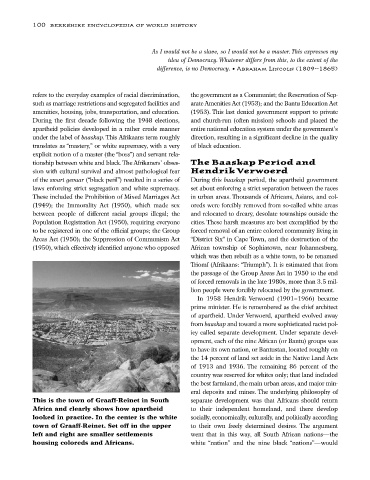
            This is the town of Graaff-Reinet in South          separate development was that Africans should return
            Africa and clearly shows how apartheid              to their independent homeland, and there develop
            looked in practice. In the center is the white      socially, economically, culturally, and politically according
            town of Graaff-Reinet. Set off in the upper         to their own freely determined desires. The argument
            left and right are smaller settlements              went that in this way, all South African nations—the
            housing coloreds and Africans.                      white  “nation” and the nine black  “nations”—would

