


Page 241 - Berkshire Encyclopedia Of World History Vol I - Abraham to Coal
P. 241
126 berkshire encyclopedia of world history


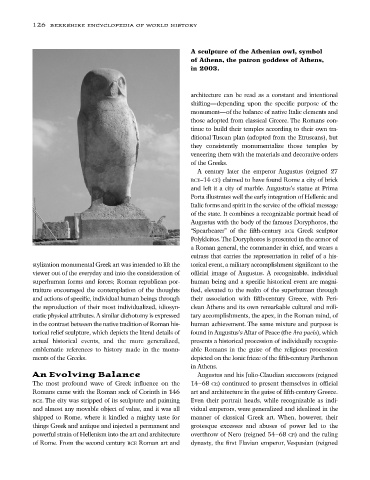
                                                                A sculpture of the Athenian owl, symbol
                                                                of Athena, the patron goddess of Athens,
                                                                in 2003.


                                                                architecture can be read as a constant and intentional
                                                                shifting—depending upon the specific purpose of the
                                                                monument—of the balance of native Italic elements and
                                                                those adopted from classical Greece. The Romans con-
                                                                tinue to build their temples according to their own tra-
                                                                ditional Tuscan plan (adopted from the Etruscans), but
                                                                they consistently monumentalize those temples by
                                                                veneering them with the materials and decorative orders
                                                                of the Greeks.
                                                                  A century later the emperor  Augustus (reigned 27
                                                                BCE–14 CE) claimed to have found Rome a city of brick
                                                                and left it a city of marble. Augustus’s statue at Prima
                                                                Porta illustrates well the early integration of Hellenic and
                                                                Italic forms and spirit in the service of the official message
                                                                of the state. It combines a recognizable portrait head of
                                                                Augustus with the body of the famous Doryphoros, the
                                                                “Spearbearer” of the  fifth-century  BCE Greek sculptor
                                                                Polykleitos.The Doryphoros is presented in the armor of
                                                                a Roman general, the commander in chief, and wears a
                                                                cuirass that carries the representation in relief of a his-
            stylization monumental Greek art was intended to lift the  torical event, a military accomplishment significant to the
            viewer out of the everyday and into the consideration of  official image of Augustus. A recognizable, individual
            superhuman forms and forces; Roman republican por-  human being and a specific historical event are magni-
            traiture encouraged the contemplation of the thoughts  fied, elevated to the realm of the superhuman through
            and actions of specific, individual human beings through  their association with  fifth-century Greece, with Peri-
            the reproduction of their most individualized, idiosyn-  clean Athens and its own remarkable cultural and mili-
            cratic physical attributes.A similar dichotomy is expressed  tary accomplishments, the apex, in the Roman mind, of
            in the contrast between the native tradition of Roman his-  human achievement. The same mixture and purpose is
            torical relief sculpture, which depicts the literal details of  found in Augustus’s Altar of Peace (the Ara pacis), which
            actual historical events, and the more generalized,  presents a historical procession of individually recogniz-
            emblematic references to history made in the monu-  able Romans in the guise of the religious procession
            ments of the Greeks.                                depicted on the Ionic frieze of the fifth-century Parthenon
                                                                in Athens.
            An Evolving Balance                                   Augustus and his Julio-Claudian successors (reigned
            The most profound  wave of Greek influence on the    14–68 CE) continued to present themselves in official
            Romans came with the Roman sack of Corinth in 146   art and architecture in the guise of fifth-century Greece.
            BCE. The city was stripped of its sculpture and painting  Even their portrait heads, while recognizable as indi-
            and almost any movable object of value, and it was all  vidual emperors, were generalized and idealized in the
            shipped to Rome, where it kindled a mighty taste for  manner of classical Greek art. When, however, their
            things Greek and antique and injected a permanent and  grotesque excesses and abuses of power led to the
            powerful strain of Hellenism into the art and architecture  overthrow of Nero (reigned 54–68 CE) and the ruling
            of Rome. From the second century BCE Roman art and  dynasty, the first Flavian emperor, Vespasian (reigned

