


Page 204 - Encyclopedia Of World History Vol III
P. 204
isabella i 1023


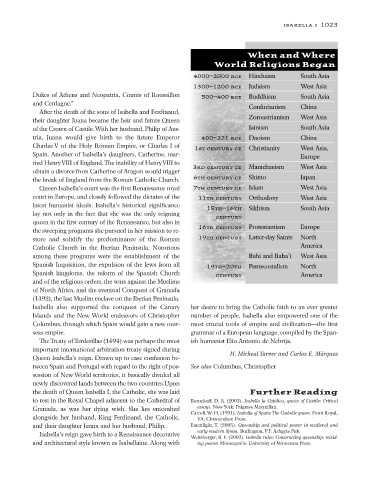
                                                                                   When and Where
                                                                        World Religions Began

                                                                 4000–2500 bce     Hinduism         South Asia
                                                                 1300–1200 bce     Judaism          West Asia
            Dukes of Athens and Neopatria, Counts of Roussillon
                                                                    500–400 bce    Buddhism         South Asia
            and Cerdagne.”
                                                                                   Confucianism     China
              After the death of the sons of Isabella and Ferdinand,
                                                                                   Zoroastrianism   West Asia
            their daughter Juana became the heir and future Queen
            of the Crown of Castile.With her husband, Philip of Aus-               Jainism          South Asia
            tria, Juana would give birth to the future Emperor      400–221 bce    Daoism           China
            Charles V of the Holy Roman Empire, or Charles I of
                                                                 1st century ce    Christianity     West Asia,
            Spain. Another of Isabella’s daughters, Catherine, mar-                                 Europe
            ried HenryVIII of England.The inability of HenryVIII to
                                                                 3rd century ce    Manichaeism      West Asia
            obtain a divorce from Catherine of Aragon would trigger
            the break of England from the Roman Catholic Church.  6th century ce   Shinto           Japan
              Queen Isabella’s court was the first Renaissance royal  7th century ce  Islam          West Asia
            court in Europe, and closely followed the dictates of the  11th century  Orthodoxy      West Asia
            latest humanist ideals. Isabella’s historical significance
                                                                     15th–16th  Sikhism             South Asia
            lay not only in the fact that she was the only reigning
                                                                        century
            queen in the first century of the Renaissance, but also in
                                                                   16th century    Protestantism    Europe
            the sweeping programs she pursued in her mission to re-
            store and solidify the predominance of the Roman       19th century    Latter-day Saints  North
            Catholic Church in the Iberian Peninsula. Notorious                                     America
            among these programs were the establishment of the                     Babi and Baha’i  West Asia
            Spanish Inquisition, the expulsion of the Jews from all  19th–20th  Pentecostalism      North
            Spanish kingdoms, the reform of the Spanish Church
                                                                        century                     America
            and of the religious orders, the wars against the Muslims
            of North Africa, and the eventual Conquest of Granada
            (1492), the last Muslim enclave on the Iberian Peninsula.
            Isabella also supported the conquest of the Canary  her desire to bring the Catholic faith to an ever greater
            Islands and the New World endeavors of Christopher  number of people, Isabella also empowered one of the
            Columbus, through which Spain would gain a new over-  most crucial tools of empire and civilization—the first
            seas empire.                                        grammar of a European language, compiled by the Span-
              The Treaty of Tordesillas (1494) was perhaps the most  ish humanist Elio Antonio de Nebrija.
            important international arbitration treaty signed during
                                                                             H. Micheal Tarver and Carlos E. Márquez
            Queen Isabella’s reign. Drawn up to ease confusion be-
            tween Spain and Portugal with regard to the right of pos-  See also Columbus, Christopher
            session of New World territories, it basically divided all
            newly discovered lands between the two countries.Upon
            the death of Queen Isabella I, the Catholic, she was laid               Further Reading
            to rest in the Royal Chapel adjacent to the Cathedral of  Boruchoff, D. A. (2003). Isabella la Católica, queen of Castile: Critical
            Granada, as was her dying wish. She lies entombed     essays. New York: Palgrave Macmillan.
                                                                Carroll,W. H. (1991). Isabella of Spain:The Catholic queen. Front Royal,
            alongside her husband, King Ferdinand, the Catholic,  VA: Christendom Press.
            and their daughter Juana and her husband, Philip.   Earenfight, T. (2005). Queenship and political power in medieval and
                                                                  early modern Spain. Burlington,VT: Ashgate Pub.
              Isabella’s reign gave birth to a Renaissance decorative
                                                                Weissberger, B. F. (2003). Isabella rules: Constructing queenship, wield-
            and architectural style known as Isabellaine. Along with  ing power. Minneapolis: University of Minnesota Press.

