


Page 209 - Encyclopedia Of World History Vol III
P. 209
1028 berkshire encyclopedia of world history


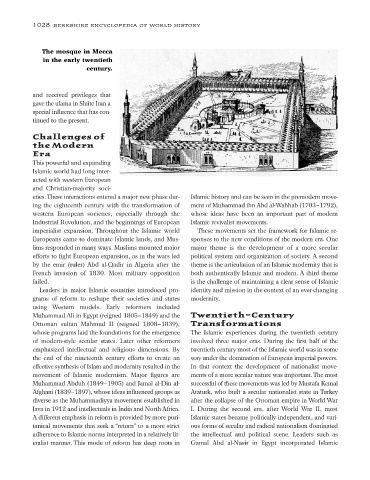
               The mosque in Mecca
               in the early twentieth
                              century.


            and received privileges that
            gave the ulama in Shiite Iran a
            special influence that has con-
            tinued to the present.


            Challenges of
            the Modern
            Era
            This powerful and expanding
            Islamic world had long inter-
            acted with western European
            and Christian-majority soci-
            eties.These interactions entered a major new phase dur-  Islamic history and can be seen in the premodern move-
            ing the eighteenth century with the transformation of  ment of Muhammad ibn Abd al-Wahhab (1703–1792),
            western European societies, especially through the  whose ideas have been an important part of modern
            Industrial Revolution, and the beginnings of European  Islamic revivalist movements.
            imperialist expansion. Throughout the Islamic world   These movements set the framework for Islamic re-
            Europeans came to dominate Islamic lands, and Mus-  sponses to the new conditions of the modern era. One
            lims responded in many ways. Muslims mounted major  major theme is the development of a more secular
            efforts to fight European expansion, as in the wars led  political system and organization of society. A second
            by the emir (ruler) Abd al-Qadir in Algeria after the  theme is the articulation of an Islamic modernity that is
            French invasion of 1830. Most military opposition   both authentically Islamic and modern. A third theme
            failed.                                             is the challenge of maintaining a clear sense of Islamic
              Leaders in major Islamic countries introduced pro-  identity and mission in the context of an ever-changing
            grams of reform to reshape their societies and states  modernity.
            using  Western models. Early reformers included
            Muhammad Ali in Egypt (reigned 1805–1849) and the   Twentieth-Century
            Ottoman sultan Mahmud II (reigned 1808–1839),       Transformations
            whose programs laid the foundations for the emergence  The Islamic experiences during the twentieth century
            of modern-style secular states. Later other reformers  involved three major eras. During the first half of the
            emphasized intellectual and religious dimensions. By  twentieth century most of the Islamic world was in some
            the end of the nineteenth century efforts to create an  way under the domination of European imperial powers.
            effective synthesis of Islam and modernity resulted in the  In that context the development of nationalist move-
            movement of Islamic modernism. Major figures are     ments of a more secular nature was important.The most
            Muhammad Abduh (1849–1905) and Jamal al-Din al-     successful of these movements was led by Mustafa Kemal
            Afghani (1839–1897), whose ideas influenced groups as  Ataturk, who built a secular nationalist state in Turkey
            diverse as the Muhammadiyya movement established in  after the collapse of the Ottoman empire in World War
            Java in 1912 and intellectuals in India and North Africa.  I. During the second era, after World War II, most
            A different emphasis in reform is provided by more puri-  Islamic states became politically independent, and vari-
            tanical movements that seek a “return” to a more strict  ous forms of secular and radical nationalism dominated
            adherence to Islamic norms interpreted in a relatively lit-  the intellectual and political scene. Leaders such as
            eralist manner. This mode of reform has deep roots in  Gamal  Abd al-Nasir in Egypt incorporated Islamic

