


Page 207 - Encyclopedia Of World History Vol III
P. 207
1026 berkshire encyclopedia of world history


            controlling the caliphal state, and the political experi-  world. Umayyad princes continued to rule in the Iberian
            ences of the community shaped the belief systems that  Peninsula, and gradually independent Islamic states were
            developed. Civil war brought an end to the era of the  established across North Africa. By the end of the tenth
            Rightly-Guided Caliphs, and the new political commu-  century CE three caliphs claimed authority in parts of the
            nity was ruled by the Umayyad dynasty (661–750 CE)  Islamic world—an Umayyad ruler in Spain, a Shiite
            and then by the Abbasid dynasty (750–1258 CE).      ruler in Egypt, and the Abbasid caliph in Baghdad. Local
              Early Abbasid caliphs built a new capital at Baghdad,  military rulers, who came to take the title of “sultan,”
            not far from the location of ancient imperial capitals.  increasingly dominated political affairs. The Mongol
            Although the Abbasid state was strong, it never estab-  conquest of Baghdad in 1258 CE brought an end to the
            lished control over all of the territories of the Islamic  Abbasid caliphate.Although the concept of the caliphate
                                                                as a symbol of Islamic unity continued, basic Islamic po-
                                                                litical organization took the form of sultanates, repre-
                                                                senting rule by military commanders. This transforma-
                                                                tion was possible because of the evolution of the nature
                                                                of the Islamic community itself.

                                                                The Faith-Based
                                                                Community
                                                                During the early centuries of Islamic history the caliphate
                                                                was the most visible aspect of the new Islamic commu-
                                                                nity. However, the development of the Islamic belief sys-
                                                                tem provided the basis for a faith-based community that
                                                                involved more than an allegiance to a particular ruler or
                                                                political system.The definition of a legal and normative
                                                                framework that shaped politics but that was independent
                                                                of the state helped to create a sense of community iden-
                                                                tity. The development of popular devotional organiza-
                                                                tions associated with the growing importance of Sufi
                                                                (Islamic mystic) brotherhoods strengthened this identity.
                                                                  The Islamic belief system initially developed within
                                                                the framework of the caliphate but was not tied to the
                                                                specifics of the political system. Scholars, not political
                                                                leaders, undertook the important functions of interpret-
                                                                ing the Quran and organizing the traditions (hadith) of
                                                                Muhammad as basic sources for law and guidance.
                                                                These scholars, literally the “learned people” (ulama),
                                                                never became an ordained clergy and maintained inde-
                                                                pendence from rulers. However, the political and legal
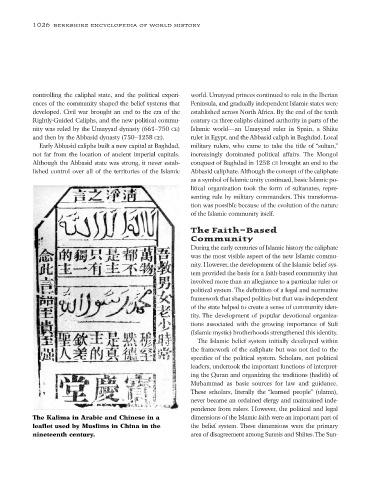
            The Kalima in Arabic and Chinese in a               dimensions of the Islamic faith were an important part of
            leaflet used by Muslims in China in the              the belief system. These dimensions were the primary
            nineteenth century.                                 area of disagreement among Sunnis and Shiites.The Sun-

