


Page 342 - Between One and Many The Art and Science of Public Speaking
P. 342
Chapter 11  Delivery: Engaging Your Audience            309


                    diacy; exciting the audience; and delivering a powerful
                    speech. Consider how you might use these dimensions
                    to maximize your nonverbal behavior in delivering your
                    speech.


                    Complementing Your Message

                    A complementary nonverbal cue serves to reinforce what
                    you verbally share with your audience. A genuine smile
                    on your face as you thank your audience for the oppor-
                    tunity to speak, for example, carries more weight than ei-
                    ther message standing on its own. There are many ways
                    to complement the delivery of your message nonverbally.
                    Changing the expression on your face, raising the pitch of
                    your voice, or even breaking off eye contact are just a few
                    of them.


                    Contradicting Your Message

                    Often, people contradict themselves nonverbally while
                    communicating interpersonally. Forcing a smile and say-
                    ing, “I had a great time” is a classic example. Although the
                    smile may have covered up how they really felt, chances
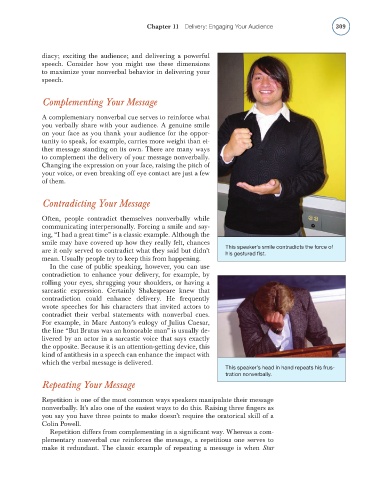
                                                                           This speaker’s smile contradicts the force of
                    are it only served to contradict what they said but didn’t
                                                                           his gestured fi st.
                    mean. Usually people try to keep this from happening.
                      In the case of public speaking, however, you can use
                    contradiction to enhance your delivery, for example, by
                    rolling your eyes, shrugging your shoulders, or having a
                    sarcastic expression. Certainly Shakespeare knew that
                    contradiction could enhance delivery. He frequently
                    wrote speeches for his characters that invited actors to
                    contradict their verbal statements with nonverbal cues.
                    For example, in Marc Antony’s eulogy of Julius Caesar,
                    the line “But Brutus was an honorable man” is usually de-
                    livered by an actor in a sarcastic voice that says exactly
                    the opposite. Because it is an attention-getting device, this
                    kind of antithesis in a speech can enhance the impact with
                    which the verbal message is delivered.
                                                                           This speaker’s head in hand repeats his frus-
                                                                           tration nonverbally.
                    Repeating Your Message

                    Repetition is one of the most common ways speakers manipulate their message
                    nonverbally. It’s also one of the easiest ways to do this. Raising three fi ngers as
                    you say you have three points to make doesn’t require the oratorical skill of a
                    Colin Powell.
                      Repetition differs from complementing in a signifi cant way. Whereas a com-
                    plementary nonverbal cue reinforces the message, a repetitious one serves to
                    make it redundant. The classic example of repeating a message is when Star

