


Page 343 - Between One and Many The Art and Science of Public Speaking
P. 343
310                   Part 3  Putting Theory Into Practice


                                                           Trek’s Mr. Spock makes the Vulcan V sign while saying,
                                                           “Live long and prosper.” Other examples include nodding
                                                           your head up and down while communicating agreement
                                                           and shaking your head from side to side when communi-
                                                           cating disagreement.


                                                           Substituting for a Verbal Cue

                                                           Have you ever seen entertainers and politicians raise their
                                                           hands and motion in the attempt to stop an audience’s
                                                           continued applause? They are using a nonverbal cue as a
                                                           substitute for a verbal one. In many circumstances, such
                                                           a nonverbal cue is both more appropriate and more effec-
                                                           tive than a verbal one. An icy stare shot in the direction
                                                           of someone talking as you speak is likely to be less disrup-
                                                           tive, for example, than politely asking the person to be
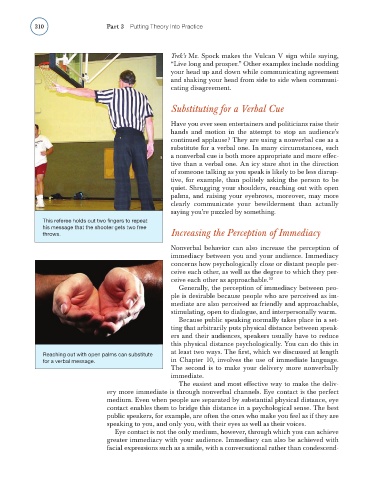
                                                           quiet. Shrugging your shoulders, reaching out with open
                                                           palms, and raising your eyebrows, moreover, may more
                                                           clearly communicate your bewilderment than actually
                                                           saying you’re puzzled by something.
                    This referee holds out two fi ngers to repeat
                    his message that the shooter gets two free
                    throws.                                Increasing the Perception of Immediacy

                                                           Nonverbal behavior can also increase the perception of
                                                           immediacy between you and your audience. Immediacy
                                                           concerns how psychologically close or distant people per-
                                                           ceive each other, as well as the degree to which they per-
                                                           ceive each other as approachable. 22
                                                             Generally, the perception of immediacy between peo-
                                                           ple is desirable because people who are perceived as im-
                                                           mediate are also perceived as friendly and approachable,
                                                           stimulating, open to dialogue, and interpersonally warm.
                                                             Because public speaking normally takes place in a set-
                                                           ting that arbitrarily puts physical distance between speak-
                                                           ers and their audiences, speakers usually have to reduce
                                                           this physical distance psychologically. You can do this in
                                                           at least two ways. The fi rst, which we discussed at length
                     Reaching out with open palms can substitute
                     for a verbal message.                 in Chapter 10, involves the use of immediate language.
                                                           The second is to make your delivery more nonverbally
                                                           immediate.
                                                             The easiest and most effective way to make the deliv-
                                        ery more immediate is through nonverbal channels. Eye contact is the perfect
                                        medium. Even when people are separated by substantial physical distance, eye
                                        contact enables them to bridge this distance in a psychological sense. The best
                                        public speakers, for example, are often the ones who make you feel as if they are
                                        speaking to you, and only you, with their eyes as well as their voices.
                                          Eye contact is not the only medium, however, through which you can achieve
                                        greater immediacy with your audience. Immediacy can also be achieved with
                                        facial expressions such as a smile, with a conversational rather than condescend-

