


Page 353 - Between One and Many The Art and Science of Public Speaking
P. 353
320                   Part 3  Putting Theory Into Practice


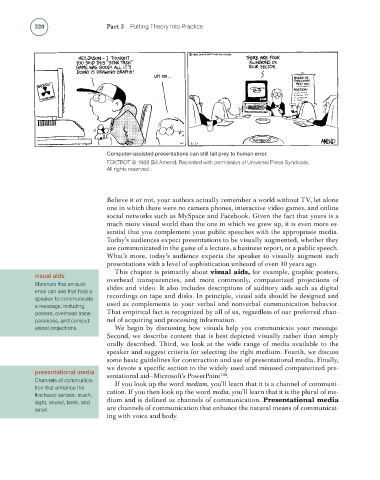
                                        Computer-assisted presentations can still fall prey to human error.
                                        FOXTROT © 1988 Bill Amend. Reprinted with permission of Universal Press Syndicate.
                                        All rights reserved.


                                        Believe it or not, your authors actually remember a world without TV, let alone
                                        one in which there were no camera phones, interactive video games, and online
                                        social networks such as MySpace and Facebook. Given the fact that yours is a
                                        much more visual world than the one in which we grew up, it is even more es-
                                        sential that you complement your public speeches with the appropriate media.
                                        Today’s audiences expect presentations to be visually augmented, whether they
                                        are communicated in the guise of a lecture, a business report, or a public speech.
                                        What’s more, today’s audience expects the speaker to visually augment such
                                        presentations with a level of sophistication unheard of even 10 years ago.
                                          This chapter is primarily about visual aids, for example, graphic posters,
                  visual aids
                                        overhead transparencies, and more commonly, computerized projections of
                  Materials that an audi-
                                        slides and video. It also includes descriptions of auditory aids such as digital
                  ence can see that help a
                                        recordings on tape and disks. In principle, visual aids should be designed and
                  speaker to communicate
                                        used as complements to your verbal and nonverbal communication behavior.
                  a message, including
                  posters, overhead trans-  That empirical fact is recognized by all of us, regardless of our preferred chan-
                  parencies, and comput-  nel of acquiring and processing information.
                  erized projections.     We begin by discussing how visuals help you communicate your message.
                                        Second, we describe content that is best depicted visually rather than simply
                                        orally described. Third, we look at the wide range of media available to the
                                        speaker and suggest criteria for selecting the right medium. Fourth, we discuss
                                        some basic guidelines for construction and use of presentational media. Finally,
                                        we devote a specifi c section to the widely used and misused computerized pre-
                  presentational media                                    TM
                                        sentational aid—Microsoft’s PowerPoint  .
                  Channels of communica-
                                          If you look up the word medium, you’ll learn that it is a channel of communi-
                  tion that enhance the
                                        cation. If you then look up the word media, you’ll learn that it is the plural of me-
                  five basic senses: touch,
                                        dium and is defi ned as channels of communication. Presentational  media
                  sight, sound, taste, and
                                        are channels of communication that enhance the natural means of communicat-
                  smell.
                                        ing with voice and body.

