


Page 354 - Between One and Many The Art and Science of Public Speaking
P. 354
Chapter 12 Using Media in Your Speech                321


                    How Visuals Help You Communicate                                            www.mhhe.com/brydon6


                    Visual aids can help you communicate your message in numerous ways. Among   To view a video for an overview
                                                                                            of the role of presentational
                    the most important are (1) communicating the organization of the speech,   media in public speaking,
                    (2) illustrating the spoken word, (3) simplifying the spoken word, and (4) com-  click on the Speech Coach
                    plementing the spoken message.                                          link on our Online Learning
                                                                                            Center Web site, and go to
                                                                                            Segment 12.1.
                    Communicating Organization

                    In our own experience we have found that our students appreciate a visual guide
                    to our lectures. As a result, we use PowerPoint slides that (1) preview the topic
                    and content of the lecture, (2) provide a brief outline students can follow as we
                    talk about the points we want to make, and (3) visually illustrate examples that
                    help us make our point and help our students better understand. We do not,
                    however, use PowerPoint as a substitute for our lectures.
                       When we fi rst talked about speech organization in Chapter 2, we introduced
                    you to the concept of transitions. Then we were talking about verbal statements
                    that let audience members know where the speaker is taking them, such as “Let’s
                    now turn to the second point I’d like to share.” Here we are talking about using
                    visual aids to achieve the same purpose.
                       People fi nd it easier to pay attention and remember when they are provided
                    with a road map that visualizes what they are hearing and seeing. A visual
                    road map also helps speakers stick to their organization, pace the tempo of
                    their speech, and free their hands from notes on
                    which they normally rely. Thus even something as
                    straightforward as a series of overhead transparen-
                    cies with main points can serve both speakers and
                    audiences. At the very least, they help the audience
                    follow the speech as it unfolds, and they help the
                    speaker stay on task.


                    Illustrating the Spoken Word

                    Nonverbal gestures are often used to illustrate what
                    we are trying to say. Visual aids serve a similar
                    function. When gestures cannot possibly convey
                    enough detail visuals come to the rescue. Would
                    you rather a friend draw you a map to an upcoming
                    event’s location or simply tell you how to get there?
                    The same applies to a speech; a clearly drawn map
                    is a much easier way of describing a location than
                    mere words.
                       Different types of visuals can be effective illus-
                    trations of the spoken message. Showing a model of
                    the human body or the inner ear serves a speaker
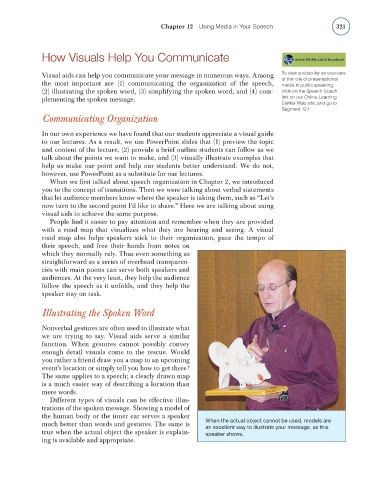
                                                                     When the actual object cannot be used, models are
                    much better than words and gestures. The same is
                                                                     an excellent way to illustrate your message, as this
                    true when the actual object the speaker is explain-  speaker shows.
                    ing is available and appropriate.

