


Page 359 - Between One and Many The Art and Science of Public Speaking
P. 359
326                   Part 3  Putting Theory Into Practice


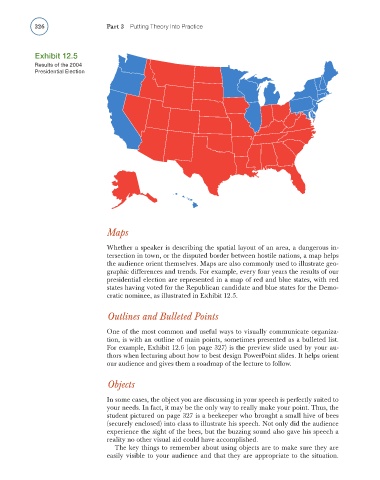
                  Exhibit 12.5
                  Results of the 2004
                  Presidential Election


                                        Maps

                                        Whether a speaker is describing the spatial layout of an area, a dangerous in-
                                        tersection in town, or the disputed border between hostile nations, a map helps
                                        the audience orient themselves. Maps are also commonly used to illustrate geo-
                                        graphic differences and trends. For example, every four years the results of our
                                        presidential election are represented in a map of red and blue states, with red
                                        states having voted for the Republican candidate and blue states for the Demo-
                                        cratic nominee, as illustrated in Exhibit 12.5.

                                        Outlines and Bulleted Points


                                        One of the most common and useful ways to visually communicate organiza-
                                        tion, is with an outline of main points, sometimes presented as a bulleted list.
                                        For example, Exhibit 12.6 (on page 327) is the preview slide used by your au-
                                        thors when lecturing about how to best design PowerPoint slides. It helps orient
                                        our audience and gives them a roadmap of the lecture to follow.

                                        Objects

                                        In some cases, the object you are discussing in your speech is perfectly suited to
                                        your needs. In fact, it may be the only way to really make your point. Thus, the
                                        student pictured on page 327 is a beekeeper who brought a small hive of bees
                                        (securely enclosed) into class to illustrate his speech. Not only did the audience
                                        experience the sight of the bees, but the buzzing sound also gave his speech a
                                        reality no other visual aid could have accomplished.
                                          The key things to remember about using objects are to make sure they are
                                        easily visible to your audience and that they are appropriate to the situation.

