


Page 361 - Between One and Many The Art and Science of Public Speaking
P. 361
328                   Part 3  Putting Theory Into Practice


                                                    few students who want to share their love of wine with students,
                                                    including samples of their favorites. For obvious reasons, fi rearms
                                                    are prohibited on our campus (except for those carried by campus
                                                    police). So too is alcohol. Thus we insist that our students tell us
                                                    in advance both their topic and any objects they plan on  using in
                                                    relationship to it.


                                                    Photographs

                                                    Sometimes a picture is worth a thousand words. You may want
                                                    to use personal photographs or those taken from another source
                                                    to illustrate an example or as a complement to a point you make.
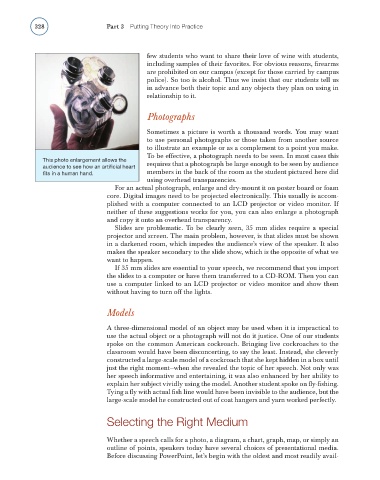
                                                    To be effective, a photograph needs to be seen. In most cases this
                     This photo enlargement allows the
                     audience to see how an artifi cial heart   requires that a photograph be large enough to be seen by audience
                     fi ts in a human hand.         members in the back of the room as the student pictured here did
                                                    using overhead transparencies.
                                          For an actual photograph, enlarge and dry-mount it on poster board or foam
                                        core. Digital images need to be projected electronically. This usually is accom-
                                        plished with a computer connected to an LCD projector or video monitor. If
                                        neither of these suggestions works for you, you can also enlarge a photograph
                                        and copy it onto an overhead transparency.
                                          Slides are problematic. To be clearly seen, 35 mm slides require a special
                                        projector and screen. The main problem, however, is that slides must be shown
                                        in a darkened room, which impedes the audience’s view of the speaker. It also
                                        makes the speaker secondary to the slide show, which is the opposite of what we
                                        want to happen.
                                          If 35 mm slides are essential to your speech, we recommend that you import
                                        the slides to a computer or have them transferred to a CD-ROM. Then you can
                                        use a computer linked to an LCD projector or video monitor and show them
                                        without having to turn off the lights.


                                        Models

                                        A three-dimensional model of an object may be used when it is impractical to
                                        use the actual object or a photograph will not do it justice. One of our students
                                        spoke on the common American cockroach. Bringing live cockroaches to the
                                        classroom would have been disconcerting, to say the least. Instead, she cleverly
                                        constructed a large-scale model of a cockroach that she kept hidden in a box until
                                        just the right moment—when she revealed the topic of her speech. Not only was
                                        her speech informative and entertaining, it was also enhanced by her ability to
                                        explain her subject vividly using the model. Another student spoke on fl y-fi shing.
                                        Tying a fl y with actual fi sh line would have been invisible to the audience, but the
                                        large-scale model he constructed out of coat hangers and yarn worked perfectly.


                                        Selecting the Right Medium


                                        Whether a speech calls for a photo, a diagram, a chart, graph, map, or simply an
                                        outline of points, speakers today have several choices of presentational media.
                                        Before discussing PowerPoint, let’s begin with the oldest and most readily avail-

