


Page 362 - Between One and Many The Art and Science of Public Speaking
P. 362
Chapter 12 Using Media in Your Speech                329


                    able methods: blackboards (or whiteboards), poster boards, fl ip charts, overhead
                    transparencies, handouts, audio recordings, and audiovisual recordings.


                    Blackboards and Whiteboards

                    Chalkboards or erasable marker whiteboards are sometimes useful for putting
                    up brief information. For example, a phone number, an address, or a few key
                    words can be quickly placed on a chalkboard. However, to use this as your sole
                    or major visual means of support is not wise. For one thing, you have to turn
                    your back on your audience in order to use the board. Anything more extensive
                    than a few words will take longer to write than you would need for a prepared
                    visual aid, such as an overhead transparency.
                       In short, the chalkboard is of limited use to most speakers. Erasable marker
                    whiteboards have one advantage: their white background and the availability
                    of multicolored markers make them more interesting to use than the traditional
                    black or green chalkboard. However, you still have to take your eyes off your
                    audience and turn your back in order to use them effectively.

                    Poster Board

                    Poster board is one of the most common mediums used by students for their
                    speeches. A well-drawn and lettered poster board can signifi cantly enhance an
                    audience’s response to a speech. By the same token, poorly drawn or lettered
                    poster boards detract from both the speaker’s credibility and the content of the
                    speech.
                       Poster boards are well suited to speakers who are just learning to comple-
                    ment their content and delivery with visual media. You can draw diagrams and
                    charts on poster board, and you can use poster board to mount illustrations,
                    photographs, and maps. No matter how you use poster boards, however, take
                    care both in their construction and in how you display them as you deliver your
                    speech.
                       As is the case with any presentational medium, poster boards should add
                    something to your speech that would otherwise be missing. Construct them in as
                    professional a manner as possible. This doesn’t mean
                    that you have to hire a graphic artist, but it does mean
                    taking advantage of these basic guidelines.
                       •  Draw illustrations, diagrams, or charts with
                        colored marking pens.
                       •  Use rub-on letters and numerals for your text.
                       •  Use colored poster board only if it contrasts
                        markedly with the lettering you use.
                       •  Choose very sturdy poster board, preferably
                        with a foam core.
                       •  Use an easel whenever possible.
                       Flimsy posters have a tendency to curl up or fall
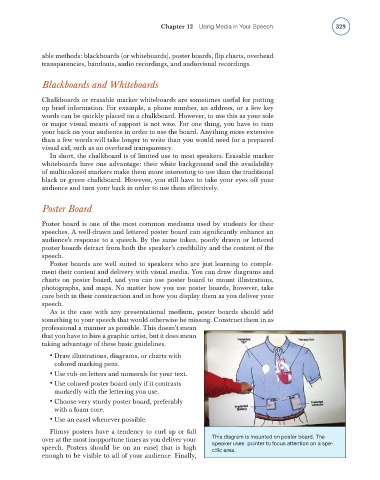
                    over at the most inopportune times as you deliver your   This diagram is mounted on poster board. The
                                                                       speaker uses  pointer to focus attention on a spe-
                    speech. Posters should be on an easel that is high
                                                                       cifi c area.
                    enough to be visible to all of your audience. Finally,

