


Page 262 - Biodegradable Polyesters
P. 262
240  10  Highly Toughened Polylactide-Based Materials through Melt-Blending Techniques

                               M
                  O       R–O    O         OM          M  O                O
              O      RO–M   O           O     OR       O     OR       M  O     OR
                  n              n          n              n                  n
                                                                                 O
                                                                              O
                                                                             p
                                                                                 n
                                       O     O           H O, H +      O     O
                                                          2
                                 H   O     O     OR              M   O     O     OR
                                         n  p   n                        n  p   n
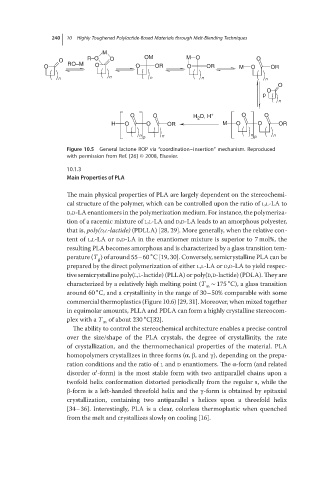
                    Figure 10.5 General lactone ROP via “coordination–insertion” mechanism. Reproduced
                    with permission from Ref. [26] © 2008, Elsevier.
                    10.1.3
                    Main Properties of PLA
                    The main physical properties of PLA are largely dependent on the stereochemi-
                    cal structure of the polymer, which can be controlled upon the ratio of L,L-LA to
                    D,D-LA enantiomers in the polymerization medium. For instance, the polymeriza-
                    tion of a racemic mixture of L,L-LA and D,D-LA leads to an amorphous polyester,
                    that is, poly(D,L-lactide) (PDLLA) [28, 29]. More generally, when the relative con-
                    tent of L,L-LA or D,D-LA in the enantiomer mixture is superior to 7 mol%, the
                    resulting PLA becomes amorphous and is characterized by a glass transition tem-
                                            ∘
                    perature (T )ofaround55–60 C [19, 30]. Conversely, semicrystalline PLA can be
                             g
                    prepared by the direct polymerization of either L,L-LA or D,D-LA to yield respec-
                    tive semicrystalline poly(L,L-lactide) (PLLA) or poly(D,D-lactide) (PDLA). They are
                                                                   ∘
                    characterized by a relatively high melting point (T ∼ 175 C), a glass transition
                                                            m
                             ∘
                    around 60 C, and a crystallinity in the range of 30–50% comparable with some
                    commercial thermoplastics (Figure 10.6) [29, 31]. Moreover, when mixed together
                    in equimolar amounts, PLLA and PDLA can form a highly crystalline stereocom-
                                          ∘
                    plex with a T of about 230 C[32].
                               m
                      The ability to control the stereochemical architecture enables a precise control
                    over the size/shape of the PLA crystals, the degree of crystallinity, the rate
                    of crystallization, and the thermomechanical properties of the material. PLA
                    homopolymers crystallizes in three forms (α, β,and γ), depending on the prepa-
                    ration conditions and the ratio of L and D enantiomers. The α-form (and related
                             ′
                    disorder α -form) is the most stable form with two antiparallel chains upon a
                    twofold helix conformation distorted periodically from the regular s, while the
                    β-form is a left-handed threefold helix and the γ-form is obtained by epitaxial
                    crystallization, containing two antiparallel s helices upon a threefold helix
                    [34–36]. Interestingly, PLA is a clear, colorless thermoplastic when quenched
                    from the melt and crystallizes slowly on cooling [16].

