


Page 188 - Biomedical Engineering and Design Handbook Volume 2, Applications
P. 188
DESIGN OF CONTROLLED-RELEASE DRUG DELIVERY SYSTEMS  167

                            In Fig. 6.3, C is drug concentration in the reservoir or matrix compartment, C is solubility of
                                      R
                                                                                      P
                          drug in the polymer phase, C is the concentration in diffusion layer, h is thickness of the mem-
                                                                              m
                                               D
                          brane, h is thickness of diffusion layer, and h + dh indicates the changing thickness of the deple-
                                                           P
                                                               P
                               d
                          tion zone of matrix.
                            In a reservoir system, if the active agent is in a saturated state, the driving force is kept constant
                          until it is no longer saturated. For matrix systems, because of the changing thickness of the deple-
                                                                          10
                          tion zone, release kinetics is a function of the square root of time. A typical reservoir system for
                          transdermal delivery consists of a backing layer, a rate-limiting membrane, protective liner, and a
                          reservoir compartment. The drug is enclosed within the reservoir compartment and released through
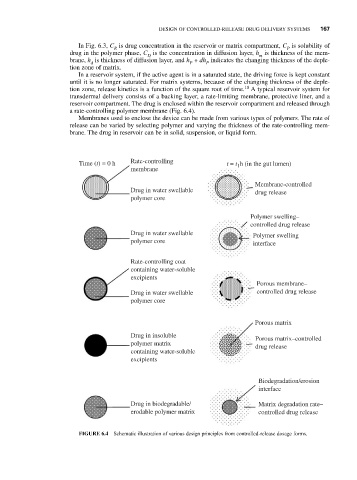
                          a rate-controlling polymer membrane (Fig. 6.4).
                            Membranes used to enclose the device can be made from various types of polymers. The rate of
                          release can be varied by selecting polymer and varying the thickness of the rate-controlling mem-
                          brane. The drug in reservoir can be in solid, suspension, or liquid form.
                            Time (t) = 0 h  Rate-controlling         t = t h (in the gut lumen)
                                                                        1
                                           membrane
                                                                             Membrane-controlled
                                           Drug in water swellable           drug release
                                           polymer core

                                                                            Polymer swelling–
                                                                            controlled drug release
                                           Drug in water swellable
                                                                            Polymer swelling
                                           polymer core
                                                                            interface
                                           Rate-controlling coat
                                           containing water-soluble
                                           excipients
                                                                             Porous membrane–
                                           Drug in water swellable           controlled drug release
                                           polymer core

                                                                             Porous matrix

                                           Drug in insoluble
                                                                             Porous matrix–controlled
                                           polymer matrix
                                                                             drug release
                                           containing water-soluble
                                           excipients
                                                                              Biodegradation/erosion
                                                                              interface
                                           Drug in biodegradable/             Matrix degradation rate–
                                           erodable polymer matrix            controlled drug release


                            FIGURE 6.4 Schematic illustration of various design principles from controlled-release dosage forms.

