


Page 433 - Biomimetics : Biologically Inspired Technologies
P. 433
Bar-Cohen : Biomimetics: Biologically Inspired Technologies DK3163_c016 Final Proof page 419 21.9.2005 11:49pm
Biomimetic and Biologically Inspired Control 419
h
T
½ T d n , and k 0 .
which is parameterized by c 0 ¼ c 1 c 2 c n , d 0 ¼ d 1 d 2
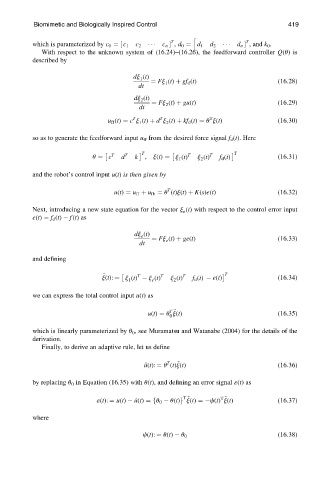
With respect to the unknown system of (16.24)–(16.26), the feedforward controller Q(u)is
described by
dj (t)
1
¼ Fj (t) þ gf d (t) (16:28)
1
dt
dj (t)
2
¼ Fj (t) þ gu(t) (16:29)
2
dt
T
T
T
u ff (t) ¼ c j (t) þ d j (t) þ kf d (t) ¼ u j(t) (16:30)
1
2
so as to generate the feedforward input u ff from the desired force signal f d (t). Here
T T
u ¼ c T d T k , j(t) ¼ j (t) T j (t) T f d (t) (16:31)
2
1
and the robot’s control input u(t) is then given by
T
u(t) ¼ u ff þ u fb ¼ u (t)j(t) þ K(s)e(t) (16:32)
Next, introducing a new state equation for the vector j (t) with respect to the control error input
e
e(t) ¼ f d (t) f(t)as
dj (t)
e
¼ Fj (t) þ ge(t) (16:33)
e
dt
and defining
T
~
T
j j(t): ¼ j (t) j (t) T j (t) T f d (t) e(t) (16:34)
1 e 2
we can express the total control input u(t)as
T ~
u(t) ¼ u j(t) (16:35)
j
0
which is linearly parameterized by u 0 , see Muramatsu and Watanabe (2004) for the details of the
derivation.
Finally, to derive an adaptive rule, let us define
~
T
j
^ u u(t): ¼ u (t)j(t) (16:36)
by replacing u 0 in Equation (16.35) with u(t), and defining an error signal «(t)as
~
T ~
T
f
j
u
«(t): ¼ u(t) ^ u(t) ¼ u 0 u(t)g j(t) ¼ c(t) j(t) (16:37)
j
where
(16:38)
c(t): ¼ u(t) u 0

