


Page 146 - Biorefinery 2030 Future Prospects for the Bioeconomy (2015)
P. 146
114                                                         Annexes


            – cost structure (OPEX)
            – Turnover, value added, workforce (over last 5 years?)

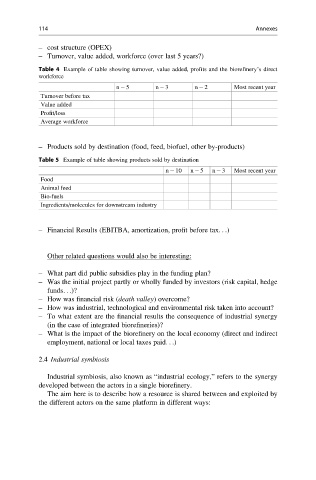
            Table 4 Example of table showing turnover, value added, profits and the biorefinery’s direct
            workforce
                                 n   5      n   3      n   2      Most recent year
            Turnover before tax
            Value added
            Profit/loss
            Average workforce


            – Products sold by destination (food, feed, biofuel, other by-products)
            Table 5 Example of table showing products sold by destination
                                               n   10  n   5  n   3  Most recent year
            Food
            Animal feed
            Bio-fuels
            Ingredients/molecules for downstream industry


            – Financial Results (EBITBA, amortization, profit before tax...)


              Other related questions would also be interesting:

            – What part did public subsidies play in the funding plan?
            – Was the initial project partly or wholly funded by investors (risk capital, hedge
              funds...)?
            – How was financial risk (death valley) overcome?
            – How was industrial, technological and environmental risk taken into account?
            – To what extent are the financial results the consequence of industrial synergy
              (in the case of integrated biorefineries)?
            – What is the impact of the biorefinery on the local economy (direct and indirect
              employment, national or local taxes paid...)

            2.4 Industrial symbiosis

              Industrial symbiosis, also known as “industrial ecology,” refers to the synergy
            developed between the actors in a single biorefinery.
              The aim here is to describe how a resource is shared between and exploited by
            the different actors on the same platform in different ways:

