


Page 147 - Biorefinery 2030 Future Prospects for the Bioeconomy (2015)
P. 147
Annexes                                                         115

            – Horizontally: for example, drilled water can be shared between the actors based
              on a weighting system approved by the regulator. Waste or other kinds of waste
              with an organic content can be used contractually for crop spraying.
            – Vertically: by-products resulting from an initial production process (raw juice,
              alcohol, ethanol) can be stored and then reused in a second process. The steam
              produced by a key actor (sugar factory, for example) can be sold to other actors
              on the platform. CO 2 produced during fermentation can be transferred to other
              industrial actors downstream in the value chain (starch producer).
            – Cascades: when this process is repeated over several consecutive levels of
              processing, a genuine cascade of products and by-products is generated and
              exchanged in the same biorefinery, from biomass and the result of its initial
              processing to a wide range of diverse products at the end of the cascade.


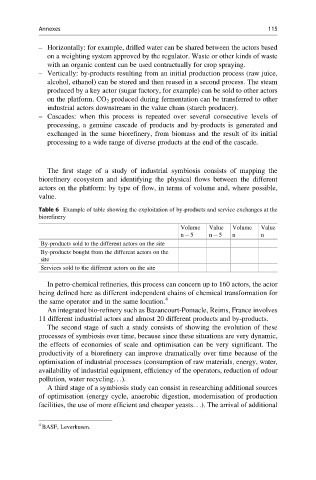
              The first stage of a study of industrial symbiosis consists of mapping the
            biorefinery ecosystem and identifying the physical flows between the different
            actors on the platform: by type of flow, in terms of volume and, where possible,
            value.
            Table 6 Example of table showing the exploitation of by-products and service exchanges at the
            biorefinery
                                                   Volume  Value  Volume  Value
                                                   n   5   n   5  n      n
            By-products sold to the different actors on the site
            By-products bought from the different actors on the
            site
            Services sold to the different actors on the site

              In petro-chemical refineries, this process can concern up to 160 actors, the actor
            being defined here as different independent chains of chemical transformation for
            the same operator and in the same location.  4
              An integrated bio-refinery such as Bazancourt-Pomacle, Reims, France involves
            11 different industrial actors and almost 20 different products and by-products.
              The second stage of such a study consists of showing the evolution of these
            processes of symbiosis over time, because since these situations are very dynamic,
            the effects of economies of scale and optimisation can be very significant. The
            productivity of a biorefinery can improve dramatically over time because of the
            optimisation of industrial processes (consumption of raw materials, energy, water,
            availability of industrial equipment, efficiency of the operators, reduction of odour
            pollution, water recycling...).
              A third stage of a symbiosis study can consist in researching additional sources
            of optimisation (energy cycle, anaerobic digestion, modernisation of production
            facilities, the use of more efficient and cheaper yeasts...). The arrival of additional

            4
             BASF, Leverkusen.

