


Page 317 - Buried Pipe Design
P. 317
288   Chapter Six

           The ring compression method specifies that the ring compression
         thrust P D/2 must be less than the allowable thrust, which  is the
                 v
         allowable strength of longitudinal seam per unit length of pipe. This
         method assumes that the vertical soil pressure on the pipe is P and
                                                                     v
         that the soil completely supports the ring radially.
           A modification of the ring compression concept includes wall crushing
         and wall buckling in addition to seam strength as performance limits.
         The computed stress is S   P (D/2A) (see Fig. 6.2), and the ultimate
                                      v
         stress f is the crushing strength of the wall (yield point stress), the buck-
                c
         ling strength of the wall, or seam strength. Again, it must be assumed
         that the soil  is precisely as compressible as the ring cross-section.
         Actually soil is not precisely as compressible as the ring cross-section,
         and so the soil pressure on the ring is not exactly P . But another prob-
                                                        v
         lem arises also. Which wall strength, crushing or buckling, actually con-
         trols performance and so limits design? At one extreme, if the soil could
         resist all ring deflection, crushing would control and f would be the
                                                             c
         yield point stress. At the other extreme, if the soil were fluid, (i.e., could
         resist no ring deflection), buckling may control. Of course, soil is some-
         where between the two extremes and is compressible.
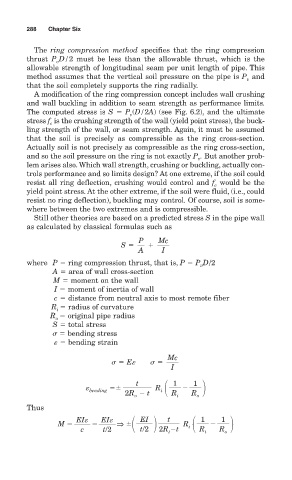
           Still other theories are based on a predicted stress S in the pipe wall
         as calculated by classical formulas such as

                                        P    Mc
                                   S
                                        A     I
         where P   ring compression thrust, that is, P   P D/2
                                                         v
                A   area of wall cross-section
                 M   moment on the wall
                 I   moment of inertia of wall
                 c   distance from neutral axis to most remote fiber
                R   radius of curvature
                  i
                R   original pipe radius
                 o
                S   total stress
                    bending stress
                     bending strain
                                                Mc
                                     E
                                                 I

                                       t         1     1
                                            R i
                          bending
                                    2R   t       R    R
                                       o          i     o
         Thus

                       EI     EI        EI      t        1    1
                  M               ⇒                 R i
                        c     t/2       t/2  2R  t      R i   R o
                                                i

