


Page 321 - Buried Pipe Design
P. 321
292   Chapter Six

         and ring deflection were constrained to zero. Also, for a given gage of
         steel, the cross-sectional area increases as the corrugations height is
         increased.
           In Utah State University tests, it was shown that ring flexibility
              2
         (D/r) influences crushing strength in loose soil. This is seen in Fig. 6.4
         where the curves drop off to the right as the ring flexibility increases.

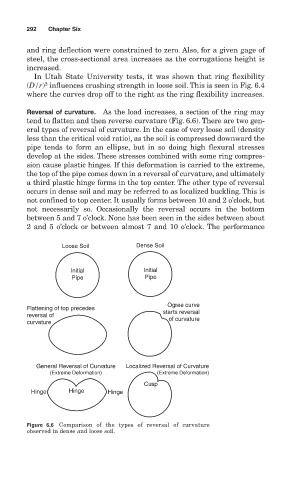
         Reversal of curvature. As the load increases, a section of the ring may
         tend to flatten and then reverse curvature (Fig. 6.6). There are two gen-
         eral types of reversal of curvature. In the case of very loose soil (density
         less than the critical void ratio), as the soil is compressed downward the
         pipe tends to form an ellipse, but  in so doing high flexural stresses
         develop at the sides. These stresses combined with some ring compres-
         sion cause plastic hinges. If this deformation is carried to the extreme,
         the top of the pipe comes down in a reversal of curvature, and ultimately
         a third plastic hinge forms in the top center. The other type of reversal
         occurs in dense soil and may be referred to as localized buckling. This is
         not confined to top center. It usually forms between 10 and 2 o’clock, but
         not necessarily so. Occasionally the reversal occurs  in the bottom
         between 5 and 7 o’clock. None has been seen in the sides between about
         2 and 5 o’clock or between almost 7 and 10 o’clock. The performance


                   Loose Soil          Dense Soil


                     Initial             Initial
                      Pipe                Pipe


                                                Ogree curve
         Flattening of top precedes
                                              starts reversal
         reversal of
         curvature                              of curvature


            General Reversal of Curvature  Localized Reversal of Curvature
                (Extreme Deformation)        (Extreme Deformation)
                                         Cusp
           Hinge     Hinge     Hinge


         Figure 6.6 Comparison of the types of reversal of curvature
         observed in dense and loose soil.

