


Page 323 - Buried Pipe Design
P. 323
294   Chapter Six

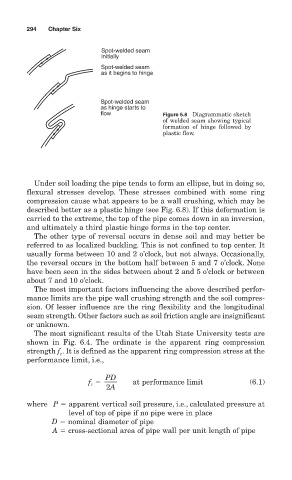
                              Spot-welded seam
                              initially
                              Spot-welded seam
                              as it begins to hinge


                              Spot-welded seam
                              as hinge starts to
                              flow            Figure 6.8 Diagrammatic sketch
                                              of welded seam showing typical
                                              formation of hinge followed by
                                              plastic flow.


           Under soil loading the pipe tends to form an ellipse, but in doing so,
         flexural stresses develop. These stresses combined with some ring
         compression cause what appears to be a wall crushing, which may be
         described better as a plastic hinge (see Fig. 6.8). If this deformation is
         carried to the extreme, the top of the pipe comes down in an inversion,
         and ultimately a third plastic hinge forms in the top center.
           The other type of reversal occurs in dense soil and may better be
         referred to as localized buckling. This is not confined to top center. It
         usually forms between 10 and 2 o’clock, but not always. Occasionally,
         the reversal occurs in the bottom half between 5 and 7 o’clock. None
         have been seen in the sides between about 2 and 5 o’clock or between
         about 7 and 10 o’clock.
           The most important factors influencing the above described perfor-
         mance limits are the pipe wall crushing strength and the soil compres-
         sion. Of lesser  influence are the ring flexibility and the longitudinal
         seam strength. Other factors such as soil friction angle are insignificant
         or unknown.
           The most significant results of the Utah State University tests are
         shown  in Fig. 6.4. The ordinate  is the apparent ring compression
         strength f . It is defined as the apparent ring compression stress at the
                  c
         performance limit, i.e.,

                               PD
                          f c         at performance limit            (6.1)
                               2A
         where P   apparent vertical soil pressure, i.e., calculated pressure at
                     level of top of pipe if no pipe were in place
                D   nominal diameter of pipe
                A   cross-sectional area of pipe wall per unit length of pipe

