


Page 329 - Buried Pipe Design
P. 329
300   Chapter Six

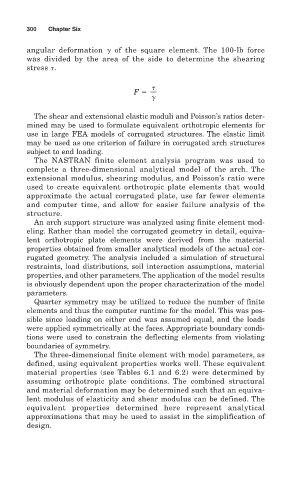
         angular deformation    of the square element. The 100-lb force
         was divided by the area of the side to determine the shearing
         stress  .


                                       F


           The shear and extensional elastic moduli and Poisson’s ratios deter-
         mined may be used to formulate equivalent orthotropic elements for
         use  in large FEA models of corrugated structures. The elastic limit
         may be used as one criterion of failure in corrugated arch structures
         subject to end loading.
           The NASTRAN finite element analysis program was used to
         complete a three-dimensional analytical model of the arch. The
         extensional modulus, shearing modulus, and Poisson’s ratio were
         used to create equivalent orthotropic plate elements that would
         approximate the actual corrugated plate, use far fewer elements
         and computer time, and allow for easier failure analysis of the
         structure.
           An arch support structure was analyzed using finite element mod-
         eling. Rather than model the corrugated geometry in detail, equiva-
         lent orthotropic plate elements were derived from the material
         properties obtained from smaller analytical models of the actual cor-
         rugated geometry. The analysis  included a simulation of structural
         restraints, load distributions, soil interaction assumptions, material
         properties, and other parameters. The application of the model results
         is obviously dependent upon the proper characterization of the model
         parameters.
           Quarter symmetry may be utilized to reduce the number of finite
         elements and thus the computer runtime for the model. This was pos-
         sible since loading on either end was assumed equal, and the loads
         were applied symmetrically at the faces. Appropriate boundary condi-
         tions were used to constrain the deflecting elements from violating
         boundaries of symmetry.
           The three-dimensional finite element with model parameters, as
         defined, using equivalent properties works well. These equivalent
         material properties (see  Tables 6.1 and 6.2) were determined by
         assuming orthotropic plate conditions. The combined structural
         and material deformation may be determined such that an equiva-
         lent modulus of elasticity and shear modulus can be defined. The
         equivalent properties determined here represent analytical
         approximations that may be used to assist in the simplification of
         design.

