


Page 331 - Calculus Demystified
P. 331
318         (b)  x = 2 and x =−2                             Final Exam
                                       (c)  x =−2 and x = 4
                                       (d)  x = 0 and x = 2
                                       (e)  x = 2 and x = 2.1
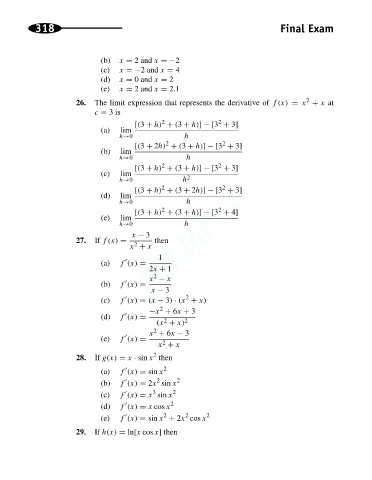
                                26.  The limit expression that represents the derivative of f(x) = x + x at
                                                                                               2
                                     c = 3is
                                                [(3 + h) + (3 + h)]−[3 + 3]
                                                        2
                                                                       2
                                       (a)  h→0               h
                                            lim
                                                [(3 + 2h) + (3 + h)]−[3 + 3]
                                                         2
                                                                        2
                                       (b)  lim
                                            h→0         2     h        2
                                       (c)  lim  [(3 + h) + (3 + h)]−[3 + 3]
                                                              2
                                            h→0         2    h          2
                                       (d)  lim  [(3 + h) + (3 + 2h)]−[3 + 3]
                                            h→0               h
                                                                       2
                                                        2
                                       (e)  lim  [(3 + h) + (3 + h)]−[3 + 4]
                                            h→0               h
                                               x − 3
                                                      then
                                27.  If f(x) =   TEAMFLY
                                                2
                                               x + x
                                                       1

                                       (a)  f (x) =  2x + 1
                                                    x − x
                                                     2
                                       (b)  f (x) =  x − 3

                                       (c)  f (x) = (x − 3) · (x + x)
                                                              2
                                                       2
                                       (d)  f (x) =  −x + 6x + 3

                                                        2
                                                     2 (x + x) 2
                                       (e)  f (x) =  x + 6x − 3

                                                        2
                                                       x + x
                                28.  If g(x) = x · sin x then
                                                     2
                                       (a)              2
                                            f (x) = sin x   2
                                                      2

                                       (b)  f (x) = 2x sin x
                                                     3
                                                           2

                                       (c)  f (x) = x sin x
                                       (d)  f (x) = x cos x 2

                                                        2
                                                              2
                                       (e)  f (x) = sin x + 2x cos x 2

                                29.  If h(x) = ln[x cos x] then


                                                         Team-Fly
                                                                  ®

