


Page 140 - Calculus Workbook For Dummies
P. 140
124       Part III: Differentiation


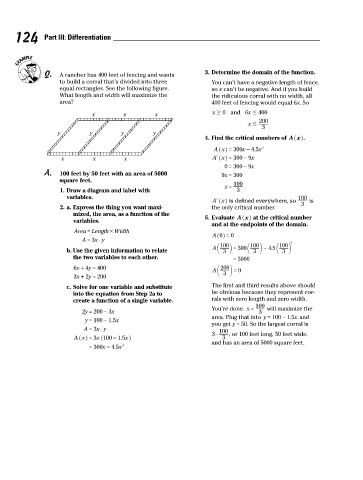
                Q.   A rancher has 400 feet of fencing and wants    3. Determine the domain of the function.
                     to build a corral that’s divided into three      You can’t have a negative length of fence,
                     equal rectangles. See the following figure.      so x can’t be negative. And if you build
                     What length and width will maximize the          the ridiculous corral with no width, all
                     area?                                            400 feet of fencing would equal 6x. So
                                                                                  x
                               x         x          x                 x $  0  and 6 #  400
                                                                                      200
                                                                                  x #
                                                                                       3
                    y         y          y         y
                                                                    4. Find the critical numbers of  A xh.
                                                                                                 ^
                                                                                     5
                                                                       A x =  300 x -  4 . x  2
                                                                        ^ h
                                                                        l ^ h
                     x         x          x                           A x =  300 -  9 x
                                                                          0 =  300 -  9 x
                A.   100 feet by 50 feet with an area of 5000            9 x =  300
                     square feet.
                                                                          x =  100
                     1. Draw a diagram and label with                         3
                       variables.                                                                 100
                                                                      A xh is defined everywhere, so   3  is
                                                                        l ^
                     2. a. Express the thing you want maxi-           the only critical number.
                         mized, the area, as a function of the      5. Evaluate  A xh at the critical number
                         variables.                                             ^
                                                                      and at the endpoints of the domain.
                         Area Length Width
                                     #
                              =
                                                                      A 0 =  0
                                                                        ^ h
                            A 3 $
                              =
                                x y
                                                                         100       100      100  2
                       b. Use the given information to relate         A c  3  m  =  300c  3  m  -  . 4 5 c  3  m
                         the two variables to each other.                    =  5000
                         6 x +  y 4 =  400                               200
                                                                      A c   m  =  0
                         3 x +  y 2 =  200                                3
                       c. Solve for one variable and substitute       The first and third results above should
                         into the equation from Step 2a to            be obvious because they represent cor-
                         create a function of a single variable.      rals with zero length and zero width.
                                                                                     100
                                                                      You’re done. x =  will maximize the
                             y 2 =  200 -  3 x                                        3
                                                                                                5
                                                                      area. Plug that into  y =  100 -  1 . x and
                                      5
                             y =  100 -  1 . x
                                                                      you get y = 50. So the largest corral is
                            A 3 $                                        100
                                 x y
                              =
                                                                      3 $   , or 100 feet long, 50 feet wide,
                                         5
                                 x 100 -
                         A x =  3 ^     1 . xh                            3
                           ^ h
                                                                      and has an area of 5000 square feet.
                              =  300 x -  4 . x  2
                                       5

