


Page 144 - Calculus Workbook For Dummies
P. 144
128       Part III: Differentiation


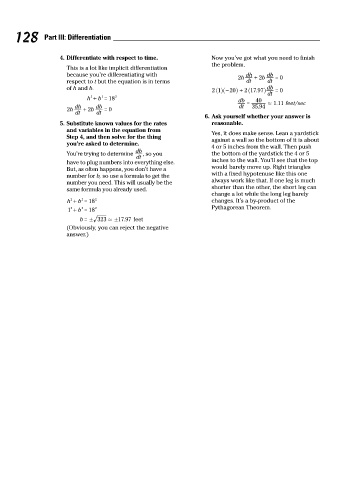
                     4. Differentiate with respect to time.           Now you’ve got what you need to finish
                                                                      the problem.
                       This is a lot like implicit differentiation
                       because you’re differentiating with                     2 h  dh  +  2 b  db  =  0
                       respect to t but the equation is in terms                  dt    dt
                       of h and b.                                    2 1 - 20 + ^h  2 17 .97h db  =  0
                                                                         h
                                                                       ^ ^
                                                                                        dt
                               2
                                  2
                             h +  b =  18 2                                    db    40
                         dh     db                                             dt  =  35 .94  .  . 1 11  feet/sec
                       2 h  +  2 b  =  0
                          dt     dt
                                                                    6. Ask yourself whether your answer is
                     5. Substitute known values for the rates         reasonable.
                       and variables in the equation from             Yes, it does make sense. Lean a yardstick
                       Step 4, and then solve for the thing           against a wall so the bottom of it is about
                       you’re asked to determine.
                                                                      4 or 5 inches from the wall. Then push
                                             db
                       You’re trying to determine   , so you          the bottom of the yardstick the 4 or 5
                                              dt
                       have to plug numbers into everything else.     inches to the wall. You’ll see that the top
                       But, as often happens, you don’t have a        would barely move up. Right triangles
                       number for b, so use a formula to get the      with a fixed hypotenuse like this one
                       number you need. This will usually be the      always work like that. If one leg is much
                       same formula you already used.                 shorter than the other, the short leg can
                                                                      change a lot while the long leg barely
                            2
                        2
                       h +  b =  18 2                                 changes. It’s a by-product of the
                        2
                            2
                       1 +  b =  18 2                                 Pythagorean Theorem.
                           b =  !  323 .  ! 17 .97 feet
                       (Obviously, you can reject the negative
                       answer.)

