


Page 148 - Calculus Workbook For Dummies
P. 148
132       Part III: Differentiation


                             Average velocity is defined as total displacement divided by total time. Say Glutius
                              completes the race in 1 hour. Because he traveled 200 palameters, his average
                              speed would be 200 palameters per hour. But because the total displacement is
                              only 100, his average velocity would be a mere 100 palameters per hour (roughly
                              7 miles per hour).
                             Speed is regular old speed, and, unlike velocity, it’s always positive (or zero). If
                              Maximus picks up speed to make the jump over the lion pit, his speed, naturally,
                              would be increasing. Note: His velocity would be decreasing — even though we
                              would see him speeding up — because his velocity would be negative and would
                              be becoming a larger and larger negative.
                             The meaning of acceleration, like velocity, (in calculus and physics) agrees with
                              the way we use it in everyday life only for movement to the right (or up). But,
                              going left (or down), it’s strange. When Glutius speeds up to jump over the lion
                              pit, we would say that he’s accelerating. But because his velocity is becoming a
                              larger and larger negative and is thus decreasing, he is technically decelerating.


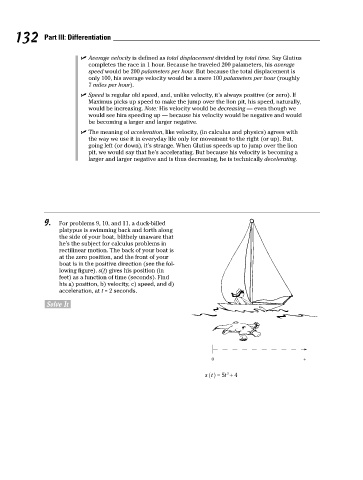
               9.   For problems 9, 10, and 11, a duck-billed
                    platypus is swimming back and forth along
                    the side of your boat, blithely unaware that
                    he’s the subject for calculus problems in
                    rectilinear motion. The back of your boat is
                    at the zero position, and the front of your
                    boat is in the positive direction (see the fol-
                    lowing figure). s(t) gives his position (in
                    feet) as a function of time (seconds). Find
                    his a) position, b) velocity, c) speed, and d)
                    acceleration, at t = 2 seconds.
                Solve It


                                                                      0                             +

                                                                           2
                                                                    s t =  t 5 +  4
                                                                     ^ h

