


Page 143 - Calculus Workbook For Dummies
P. 143
127
                                               Chapter 8: Using Differentiation to Solve Practical Problems


                Problematic Relationships: Related Rates


                          Related rates problems are the Waterloo for many a calculus student. But they’re not
                          that bad after you get the basic technique down. The best way to learn them is by
                          working through examples, so get started!

                          After working each problem, ask yourself whether the answer makes sense. Asking this
                          question is one of the best things you can do to increase your success in mathematics
                          and science. And while it’s not always possible to decide whether a math answer is
                          reasonable, when it’s possible, this inquiry should be a quick, extra step of every prob-
                          lem you do.


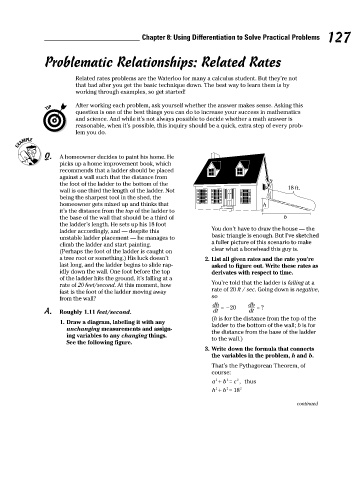
                Q.   A homeowner decides to paint his home. He
                     picks up a home improvement book, which
                     recommends that a ladder should be placed
                     against a wall such that the distance from
                     the foot of the ladder to the bottom of the
                     wall is one third the length of the ladder. Not                           18 ft.
                     being the sharpest tool in the shed, the
                     homeowner gets mixed up and thinks that                           h
                     it’s the distance from the top of the ladder to
                     the base of the wall that should be a third of                           b
                     the ladder’s length. He sets up his 18 foot
                     ladder accordingly, and — despite this           You don’t have to draw the house — the
                     unstable ladder placement — he manages to        basic triangle is enough. But I’ve sketched
                     climb the ladder and start painting.             a fuller picture of this scenario to make
                     (Perhaps the foot of the ladder is caught on     clear what a bonehead this guy is.
                     a tree root or something.) His luck doesn’t    2. List all given rates and the rate you’re
                     last long, and the ladder begins to slide rap-   asked to figure out. Write these rates as
                     idly down the wall. One foot before the top      derivates with respect to time.
                     of the ladder hits the ground, it’s falling at a
                     rate of 20 feet/second. At this moment, how      You’re told that the ladder is falling at a
                     fast is the foot of the ladder moving away       rate of 20 ft / sec. Going down is negative,
                     from the wall?                                   so
                                                                      dh    20    db  ?
                A.   Roughly 1.11 feet/second.                         dt  = -    dt  =
                                                                      (h is for the distance from the top of the
                     1. Draw a diagram, labeling it with any          ladder to the bottom of the wall; b is for
                       unchanging measurements and assign-            the distance from the base of the ladder
                       ing variables to any changing things.          to the wall.)
                       See the following figure.
                                                                    3. Write down the formula that connects
                                                                      the variables in the problem, h and b.
                                                                      That’s the Pythagorean Theorem, of
                                                                      course:
                                                                        2
                                                                           2
                                                                      a +  b =  c  2 , thus
                                                                           2
                                                                       2
                                                                      h +  b =  18 2
                                                                                                  continued

