


Page 238 - Calculus Workbook For Dummies
P. 238
222       Part IV: Integration and Infinite Series


                Volumes of Weird Solids: No, You’re

                Never Going to Need This


                          Integration works by cutting something up into an infinite number of infinitesimal
                          pieces and then adding the pieces up to compute the total. In this way, integration is
                          able to determine the volume of bizarre shapes: It cuts the shapes up into thin pieces
                          that have ordinary shapes which can then be handled by ordinary geometry. This sec-
                          tion shows you three different methods:

                             The meat slicer method: This works just like a deli meat slicer — you cut a
                              shape into flat, thin slices. You then add up the volume of the slices. This
                              method is used for odd, sometimes asymmetrical shapes.
                             The disk/washer method: With this method, you cut up the given shape into
                              thin, flat disks or washers (you know — like pancakes or squashed donuts). Used
                              for shapes with circular cross-sections.
                             The cylindrical shell method: Here, you cut your volume up into thin nested
                              shells. Each one fits snugly inside the next widest one, like telescoping tubes or
                              nested Russian dolls. Also used for shapes with circular cross-sections.


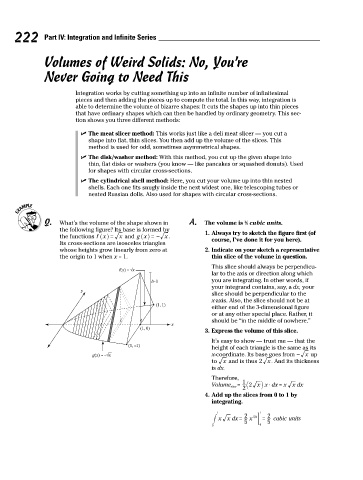
                Q.   What’s the volume of the shape shown in   A.   The volume is  ⁄5 cubic units.
                                                                                 2
                     the following figure? Its base is formed by    1. Always try to sketch the figure first (of
                     the functions f x =  x and g x = -  x .          course, I’ve done it for you here).
                                               ^ h
                                  ^ h
                     Its cross-sections are isosceles triangles
                     whose heights grow linearly from zero at       2. Indicate on your sketch a representative
                     the origin to 1 when x = 1.                      thin slice of the volume in question.
                                                                      This slice should always be perpendicu-
                                        f(x) = √x
                                                                      lar to the axis or direction along which
                                                  h=1                 you are integrating. In other words, if
                                                                      your integrand contains, say, a dx, your
                            y
                                                                      slice should be perpendicular to the
                                                                      x-axis. Also, the slice should not be at
                                                    (1, 1)
                                                                      either end of the 3-dimensional figure
                                                                      or at any other special place. Rather, it
                                                                      should be “in the middle of nowhere.”
                                                         x
                                               (1, 0)
                                                                    3. Express the volume of this slice.
                                                                      It’s easy to show — trust me — that the
                                           (1, –1)
                                                                      height of each triangle is the same as its
                               g(x) = –√x                             x-coordinate. Its base goes from -  x up
                                                                      to  x and is thus 2  x. And its thickness
                                                                      is dx.

                                                                      Therefore,
                                                                                1
                                                                                         $
                                                                                            =
                                                                      Volume slice = ` 2  x x dx x x dx
                                                                                      j
                                                                                2
                                                                    4. Add up the slices from 0 to 1 by
                                                                      integrating.
                                                                        1             1
                                                                       #  x x dx =  2  x E  =  2  cubic units
                                                                                    / 5 2
                                                                                 5      5
                                                                      0               0

