


Page 239 - Calculus Workbook For Dummies
P. 239
223
                                   Chapter 12: Who Needs Freud? Using the Integral to Solve Your Problems


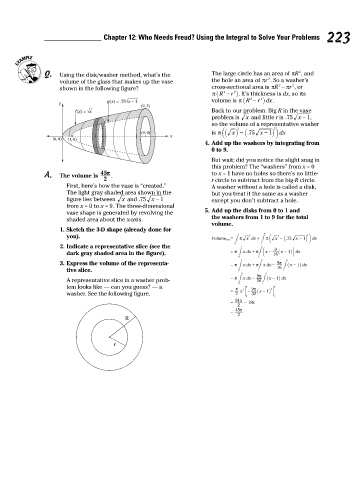
                Q.   Using the disk/washer method, what’s the         The large circle has an area of  Rπ  2 , and
                                                                                         2
                     volume of the glass that makes up the vase       the hole an area of  rπ . So a washer’s
                                                                                                 2
                     shown in the following figure?                   cross-sectional area is  Rπ  2  -  r π , or
                                                                             2
                                                                          2
                                                                      π _ R -  r i. It’s thickness is dx, so its
                                                                                      2
                                                                                   2
                                    g(x) = .75√x − 1                  volume is π _ R -  r i  dx.
                    y
                                               (9, 3)
                          f(x) = √x                                   Back to our problem. Big R in the vase
                                                                      problem is  x and little r is .75  x -  1,
                                                                      so the volume of a representative washer
                                                                               2           2
                                               (9, 0)                 is π ` c  x - `j  .75  x -  1j m  dx
                                                         x
                  (0, 0)  (1, 0)
                                                                    4. Add up the washers by integrating from
                                                                      0 to 9.
                                                                      But wait; did you notice the slight snag in
                                                                      this problem? The “washers” from x = 0
                A.   The volume is  45 π  .                           to x = 1 have no holes so there’s no little-
                                   2                                  r circle to subtract from the big-R circle.
                       First, here’s how the vase is “created.”       A washer without a hole is called a disk,
                       The light gray shaded area shown in the        but you treat it the same as a washer
                       figure lies between  x and .75  x -  1         except you don’t subtract a hole.
                       from x = 0 to x = 9. The three-dimensional
                       vase shape is generated by revolving the     5. Add up the disks from 0 to 1 and
                       shaded area about the x-axis.                  the washers from 1 to 9 for the total
                                                                      volume.
                     1. Sketch the 3-D shape (already done for
                                                                               1       9
                                                                                                     2
                       you).                                          Volume vase = #  π  x dx + #  π d  x - a .75  x -  1k n  dx
                                                                                            2
                                                                                  2
                                                                              0       1
                     2. Indicate a representative slice (see the                1     9    9
                                                                                     π
                       dark gray shaded area in the figure).                =  π #  x dx + # d x -  16 ^  x -  1hn  dx
                                                                               0     1
                                                                                1     9        9
                     3. Express the volume of the representa-               =  π #  x dx + #  x dx -  9 16 π  #^  x -  1h  dx
                                                                                     π
                       tive slice.                                             0     1        1
                                                                                9    9 π  9
                                                                              π #
                       A representative slice in a washer prob-             =   x dx -  16  #^ x -  1h  dx
                                                                               0       1
                       lem looks like — can you guess? — a                    π  9  9 π    9
                                                                                          2
                                                                            =  x F  -  ^  x -  1h F
                                                                                2
                       washer. See the following figure.                      2    32
                                                                                 0         1
                                                                              81 π
                                                                            =    -  18 π
                                                                               2
                                                                              45 π
                                                                            =
                                                                               2
                                          R
                                      r

