


Page 108 - Catalysts for Fine Chemical Synthesis Vol 1 - Robert & Poignant
P. 108
94             hydrolysis, oxidation and reduction
               6.2  ASYMMETRIC EPOXIDATION OF DISUBSTITUTED E-ALKENES
               USING A D-FRUCTOSE BASED CATALYST        [2]

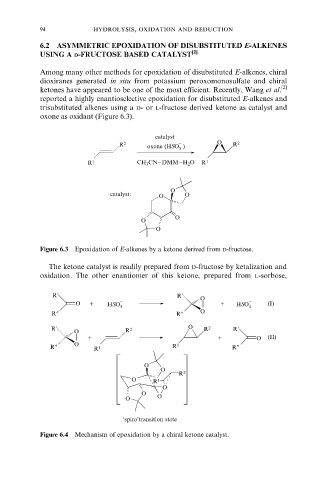
               Among many other methods for epoxidation of disubstituted E-alkenes, chiral
               dioxiranes generated in situ from potassium peroxomonosulfate and chiral
               ketones have appeared to be one of the most efficient. Recently, Wang et al. [2]
               reported a highly enantioselective epoxidation for disubstituted E-alkenes and
               trisubstituted alkenes using a d- or l-fructose derived ketone as catalyst and
               oxone as oxidant (Figure 6.3).


                                              catalyst
                                                     −
                                     R 2    oxone (HSO )       O    R 2
                                                     5
                            R 1           CH 3 CN−DMM−H 2 O  R 1


                                                   O
                                  catalyst:    O       O

                                                    O
                                           O
                                               O


               Figure 6.3  Epoxidation of E-alkenes by a ketone derived from d-fructose.

                  The ketone catalyst is readily prepared from d-fructose by ketalization and
               oxidation. The other enantiomer of this ketone, prepared from l-sorbose,


                   R9                               R9
                                     −                     O            −
                         O   +    HSO 5                         +   HSO 4    (I)
                  R99                               R99    O
                  R9                  R 2              O    R 2     R9
                         O
                            +                                  +          O  (II)
                         O
                  R99         R 1                  R 1             R99

                                           O
                                                O
                                                     R 2
                                        O     R 1
                                                O
                                           O   O
                                      O

                                      ‘spiro’transition state
               Figure 6.4  Mechanism of epoxidation by a chiral ketone catalyst.

