


Page 109 - Catalysts for Fine Chemical Synthesis Vol 1 - Robert & Poignant
P. 109
unfunctionalized alkenes a, b-unsaturated esters          95

                                                           [6]
             shows the same enantioselectivity for the epoxidation . The dioxirane is gen-
             erated in situ from potassium monoperoxosulfate and the ketone catalyst (I,
             Figure 6.4). During the oxygen-atom transfer reaction from the dioxirane to the
             E-alkene (II, Figure 6.4), a `spiro' transition state was proposed to give the (E)-
             epoxide.
               For this method, all glassware needs to be carefully washed to be free of any
             trace of metals which catalyse the decomposition of oxone.


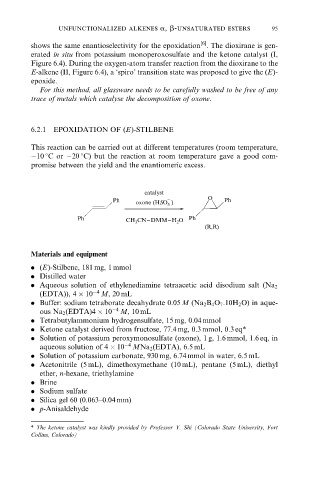
             6.2.1  EPOXIDATION OF (E)-STILBENE
             This reaction can be carried out at different temperatures (room temperature,
             ÿ10 8C or ÿ20 8C) but the reaction at room temperature gave a good com-
             promise between the yield and the enantiomeric excess.


                                            catalyst
                                   Ph             −          O   Ph
                                         oxone (HSO )
                                                  5
                         Ph            CH 3 CN−DMM−H 2 O  Ph
                                                            (R,R)


             Materials and equipment
             . (E)-Stilbene, 181 mg, 1 mmol
             . Distilled water
             . Aqueous solution of ethylenediamine tetraacetic acid disodium salt (Na 2
               (EDTA)), 4   10 ÿ4  M, 20 mL
             . Buffer: sodium tetraborate decahydrate 0.05 M (Na 2 B 4 O 7 :10H 2 O) in aque-
               ous Na 2 (EDTA)4   10 ÿ4  M, 10 mL
             . Tetrabutylammonium hydrogensulfate, 15 mg, 0.04 mmol
             . Ketone catalyst derived from fructose, 77.4 mg, 0.3 mmol, 0.3 eq*
             . Solution of potassium peroxymonosulfate (oxone), 1 g, 1.6 mmol, 1.6 eq, in
               aqueous solution of 4   10 ÿ4  MNa 2 (EDTA), 6.5 mL
             . Solution of potassium carbonate, 930 mg, 6.74 mmol in water, 6.5 mL
             . Acetonitrile (5 mL), dimethoxymethane (10 mL), pentane (5 mL), diethyl
               ether, n-hexane, triethylamine
             . Brine
             . Sodium sulfate
             . Silica gel 60 (0.063±0.04 mm)
             . p-Anisaldehyde

             * The ketone catalyst was kindly provided by Professor Y. Shi (Colorado State University, Fort
             Collins, Colorado)

