


Page 111 - Catalysts for Fine Chemical Synthesis Vol 1 - Robert & Poignant
P. 111
unfunctionalized alkenes a, b-unsaturated esters          97

             6.2.2  CONCLUSION

             Epoxidation using a chiral fructose-derived ketone is easy to carry out, as it
             occurs in aqueous conditions. The reactions were performed without any modi-
             fication of the published procedure. The glassware has to be free of trace metal,
             which can decompose the oxone; the use of a plastic spatula is recommended and
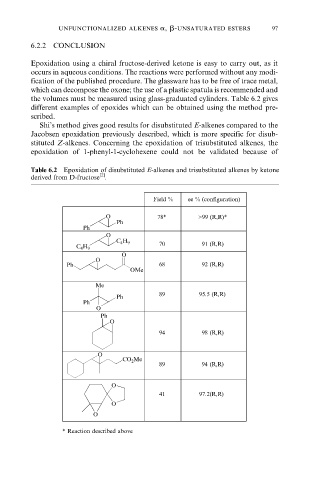
             the volumes must be measured using glass-graduated cylinders. Table 6.2 gives
             different examples of epoxides which can be obtained using the method pre-
             scribed.
               Shi's method gives good results for disubstituted E-alkenes compared to the
             Jacobsen epoxidation previously described, which is more specific for disub-
             stituted Z-alkenes. Concerning the epoxidation of trisubstituted alkenes, the
             epoxidation of 1-phenyl-1-cyclohexene could not be validated because of

             Table 6.2 Epoxidation of disubstituted E-alkenes and trisubstituted alkenes by ketone
                               [2]
             derived from D-fructose .

                                              Yield %  ee % (configuration)

                                 O             78*        >99 (R,R)*
                                    Ph
                           Ph
                                 O
                                    C 4 H 9
                                                70         91 (R,R)
                         C 4 H 9
                                     O
                              O
                      Ph                        68         92 (R,R)
                                        OMe
                              Me
                                                89        95.5 (R,R)
                                    Ph
                           Ph
                              O
                                Ph
                                  O
                                                94         98 (R,R)


                               O
                                      CO 2 Me
                                                89         94 (R,R)

                                   O
                                                41        97.2(R,R)
                                   O
                              O

                     * Reaction described above

