


Page 115 - Catalysts for Fine Chemical Synthesis Vol 1 - Robert & Poignant
P. 115
unfunctionalized alkenes a, b-unsaturated esters         101

                                                                VI
                                                                    1
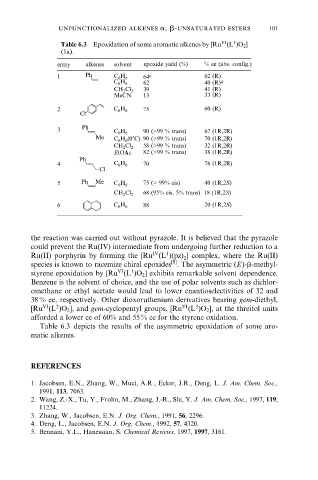
                     Table 6.3  Epoxidation of some aromatic alkenes by [Ru (L )O 2 ]
                     (1a).
                    entry   alkenes  solvent  epoxide yield (%)  % ee (abs. config.)
                    1       Ph     C 6 H 6  64 c            62 (R)
                                           62               40 (R) d
                                   C 6 H 6
                                           39               41 (R)
                                   CH 2 Cl 2
                                   MeCN    13               33 (R)
                    2              C 6 H 6  75              60 (R)
                          Cl
                    3      Ph              90 (>99 % trans)  67 (1R,2R)
                                   C 6 H 6
                              Me   C 6 H 6 (08C) 90 (>99 % trans)  70 (1R,2R)
                                           58 (>99 % trans)  32 (1R,2R)
                                   CH 2 Cl 2
                                   EtOAc   82 (>99 % trans)  38 (1R,2R)
                          Ph
                    4              C 6 H 6  70              76 (1R,2R)
                               Cl
                    5     Ph  Me   C 6 H 6  75 (> 99% cis)  40 (1R,2S)
                                           68 (95% cis, 5% trans) 18 (1R,2S)
                                   CH 2 Cl 2
                    6              C 6 H 6  88              20 (1R,2S)


             the reaction was carried out without pyrazole. It is believed that the pyrazole
             could prevent the Ru(IV) intermediate from undergoing further reduction to a
                                                 1
                                              IV
             Ru(II) porphyrin by forming the [Ru (L )(pz) ] complex, where the Ru(II)
                                                      2
                                                   [8]
             species is known to racemize chiral epoxides . The asymmetric (E)-b-methyl-
                                    VI
                                        1
             styrene epoxidation by [Ru (L )O 2 ] exhibits remarkable solvent dependence.
             Benzene is the solvent of choice, and the use of polar solvents such as dichlor-
             omethane or ethyl acetate would lead to lower enantioselectivities of 32 and
             38 % ee, respectively. Other dioxoruthenium derivatives bearing gem-diethyl,
                VI
                    2
                                                         3
                                                      VI
             [Ru (L )O 2 ], and gem-cyclopentyl groups, [Ru (L )O 2 ], at the threitol units
             afforded a lower ee of 60% and 55 % ee for the styrene oxidation.
               Table 6.3 depicts the results of the asymmetric epoxidation of some aro-
             matic alkenes.
             REFERENCES
             1. Jacobsen, E.N., Zhang, W., Muci, A.R., Ecker, J.R., Deng, L. J. Am. Chem. Soc.,
               1991, 113, 7063.
             2. Wang, Z.-X., Tu, Y., Frohn, M., Zhang, J.-R., Shi, Y. J. Am. Chem. Soc., 1997, 119,
               11224.
             3. Zhang, W., Jacobsen, E.N. J. Org. Chem., 1991, 56, 2296.
             4. Deng, L., Jacobsen, E.N. J. Org. Chem., 1992, 57, 4320.
             5. Bennani, Y.L., Hanessian, S. Chemical Reviews, 1997, 1997, 3161.

