


Page 119 - Catalysts for Fine Chemical Synthesis Vol 1 - Robert & Poignant
P. 119
asymmetric hydroxylation and aminohydroxylation 105
1
H NMR (270 MHz, CDCl 3 ) 7.26±7.19 (m, 2 H, Ar); 6.90±6.87 (m, 2 H,
Ar); 5.16 (br s, 1 H, NH); 4.73 (br s, 1 H, ArCHN); 3.82 (br s, 2 H, CH 2 O);
3.80 (s, 3 H, MeO); 1.43 (s, 9 H, CMe 3 ).
IR (CHCl 3 , cm ÿ1 3611 (O±H); 3442 (N±H); 1707 (CO)).
mp 139±141 8C (from petroleum ether-ethyl acetate, 2:1).
[a] 62:6 (c 1.0 in EtOH).
D
7.1.1 CONCLUSION
The asymmetric aminohydroxylation [3] of 4-methoxystyrene using DHQ 2
PHAL as the ligand actually produces an 85:15 mixture of (S)-N-(tert-butox-
ycarbonyl)-1-(4-methoxyphenyl)-2-hydroxyethylamine and its regioisomer as
1
shown by H NMR spectroscopy on the crude product mixture. The regioi-
somer is lower running by TLC. The product is separated from the regiosiomer
and from excess tert-butyl carbamate by careful flash column chromatography:
this is a limitation of the methodology.
(R)-N-(tert-Butoxycarbonyl)-1-(4-methoxyphenyl)-2-hydroxyethylamine(ee,
96 %) can be prepared using DHQD 2 PHAL as the ligand but this results in the
production of more of the unwanted regioisomer: a 68:32 mixture of the (R)-
product and its regioisomer were obtained. This gives a lower isolated yield of
(R)-N-(tert-butoxycarbonyl)-1-(4-methoxyphenyl)-2-hydroxyethylamine (65 %)
as compared to its enantiomer (74 %). The same trend is observed with other
[2]
styrene derivatives . A wide range of styrene derivatives give high enantio-
meric excesses using these conditions. [2,4]
7.2 ASYMMETRIC DIHYDROXYLATION OF (1-CYCLOHEXENYL)
ACETONITRILE
Jean-Michel VatE Á le
Universite  Claude Bernard Laboratoire de Chimie Organique 1, CPE-Ba Ãt. 308, 43, Boule-
vard du 11 November 1918, 69622 Villeurbanne Cedex, France.
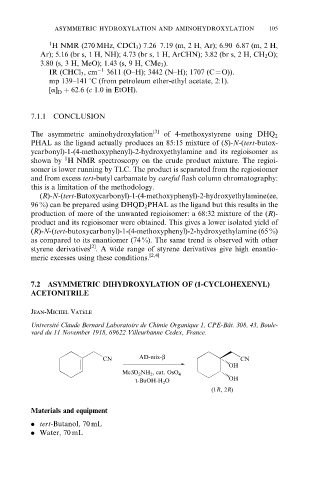
AD-mix-β
CN CN
OH
MeSO 2 NH 2 , cat. OsO 4
OH
t-BuOH-H 2 O
(1R, 2R)
Materials and equipment
. tert-Butanol, 70 mL
. Water, 70 mL

