


Page 124 - Catalysts for Fine Chemical Synthesis Vol 1 - Robert & Poignant
P. 124
110 hydrolysis, oxidation and reduction
. Silica gel 60 (230±400 mesh ASTM)
. One 10 mL round-bottomed flask with magnetic stirrer bar
. Magnetic stirrer
. Refrigerator bath (ÿ22 8C)
. Bu Èchner funnel (6 cm)
. Bu Èchner flask
. Filter paper (589 Blue ribbon)
. Rotary evaporator
. Chromatography column (15 mm diameter)
Procedure
1. In a 10 mL round-bottomed flask equipped with a magnetic stirrer bar were
placed, under an argon atmosphere, anhydrous dichloromethane (2 mL) and
diethyl l-tartrate (0.21 mL).
2. The mixture was cooled to ÿ22 8C, then titanium(IV) isopropoxide
(0.09 mL) and sulfide (61 mg solved in 1.5 mL of anhydrous dichloro-
methane) were added. Stirring was maintained for 20 minutes and hydro-
peroxide (171 mg) added to the mixture.
3. The reaction was then continued for 2 hours until completion [monitoring
by TLC (eluent: n-hexane±ethyl acetate, 5:1. Detector: UV lamp at 254 nm)
indicated complete consumption of the hydroperoxide].
4. After completion, water (1.5 mL) was added to the mixture and vigorous
stirring continued for 2 hours at room temperature. The resulting white gel
was diluted with ethyl acetate and filtered over a filter paper in a Bu Èchner
funnel. The solution was dried over sodium sulfate, filtered and concen-
trated using a rotary evaporator.
5. Purification of the crude mixture was performed by flash chromatography to
afford pure 5-(1-hydroxyethyl)-2-methyl-3-furoic acid 5a-cholestan-3b-yl
ester (4) (90 % yield) and (R)-4-bromophenyl methyl sulfoxide (3) (61 % yield).
1
The ee (92 %) was determined on representative sample by H-NMR
analysis in the presence of R-(ÿ)-(3,5-dinitrobenzoyl)-a-methylbenzyl amine.
1
H-NMR (200 MHz, CDCl 3 ): 7.68 (d, 2H, J 8.6 Hz); 7.52 (d, 2H, J
8.6 Hz); 2.72 (s, 3H).
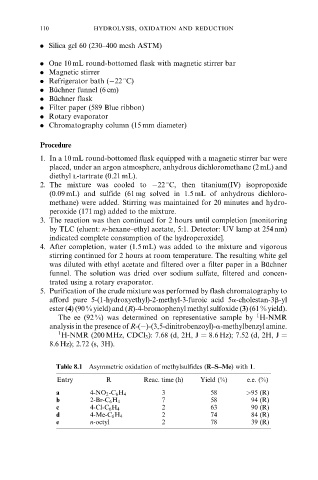
Table 8.1 Asymmetric oxidation of methylsulfides (R±S±Me) with 1.
Entry R Reac. time (h) Yield (%) e.e. (%)
a 4-NO 2 -C 6 H 4 3 58 >95 (R)
b 2-Br-C 6 H 4 7 58 94 (R)
c 4-Cl-C 6 H 4 2 63 90 (R)
d 4-Me-C 6 H 4 2 74 84 (R)
e n-octyl 2 78 39 (R)

