


Page 121 - Catalysts for Fine Chemical Synthesis Vol 1 - Robert & Poignant
P. 121
asymmetric hydroxylation and aminohydroxylation           107

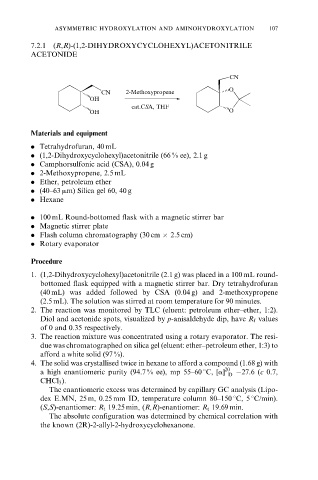
             7.2.1  (R,R)-(1,2-DIHYDROXYCYCLOHEXYL)ACETONITRILE
             ACETONIDE


                                                                   CN
                                CN     2-Methoxypropene           O
                             OH
                                        cat.CSA, THF
                             OH                                   O

             Materials and equipment
             . Tetrahydrofuran, 40 mL
             . (1,2-Dihydroxycyclohexyl)acetonitrile (66 % ee), 2.1 g
             . Camphorsulfonic acid (CSA), 0.04 g
             . 2-Methoxypropene, 2.5 mL
             . Ether, petroleum ether
             . (40±63 mm) Silica gel 60, 40 g
             . Hexane

             . 100 mL Round-bottomed flask with a magnetic stirrer bar
             . Magnetic stirrer plate
             . Flash column chromatography (30 cm   2:5 cm)
             . Rotary evaporator

             Procedure
             1. (1,2-Dihydroxycyclohexyl)acetonitrile (2.1 g) was placed in a 100 mL round-
               bottomed flask equipped with a magnetic stirrer bar. Dry tetrahydrofuran
               (40 mL) was added followed by CSA (0.04 g) and 2-methoxypropene
               (2.5 mL). The solution was stirred at room temperature for 90 minutes.
             2. The reaction was monitored by TLC (eluent: petroleum ether±ether, 1:2).
               Diol and acetonide spots, visualized by p-anisaldehyde dip, have R f values
               of 0 and 0.35 respectively.
             3. The reaction mixture was concentrated using a rotary evaporator. The resi-
               due was chromatographed on silica gel (eluent: ether±petroleum ether, 1:3) to
               afford a white solid (97 %).
             4. The solid was crystallised twice in hexane to afford a compound (1.68 g) with
               a high enantiomeric purity (94.7 % ee), mp 55±60 8C, [a] 20  ÿ27.6 (c 0.7,
                                                                  D
               CHCl 3 ).
                  The enantiomeric excess was determined by capillary GC analysis (Lipo-
               dex E.MN, 25 m, 0.25 mm ID, temperature column 80±150 8C, 5 8C/min).
               (S,S)-enantiomer: R t 19.25 min, (R,R)-enantiomer: R t 19.69 min.
                  The absolute configuration was determined by chemical correlation with
               the known (2R)-2-allyl-2-hydroxycyclohexanone.

