


Page 128 - Catalysts for Fine Chemical Synthesis Vol 1 - Robert & Poignant
P. 128
Catalysts for Fine Chemical Synthesis: Hydrolysis, Oxidation and Reduction. Volume 1
Edited by Stan M Roberts and Geraldine Poignant
Copyright 2002 John Wiley & Sons, Ltd.
ISBN: 0-471-98123-0
9 Asymmetric Reduction of
Ketones Using Organometallic
Catalysts
CONTENTS
9.1 Introduction . . . . . . . . . . . . . . . . . . . . 115
9.2 Asymmetric hydrogenation using a metal catalyst: [Ru((S)-BiNAP)]. . . . 117
9.3 Asymmetric transfer hydrogenation of b-ketoesters
Kathelyne Everaere, Jean-FranCois Carpentier, AndrE Â Mortreux and
Ë
Michel Bulliard . . . . . . . . . . . . . . . . . . . 121
9.4 (S,S)-1,2-bis(tert-butylmethylphosphino)ethane (BisP*): synthesis
and use as a ligand
T. Imamoto . . . . . . . . . . . . . . . . . . . . . 123
9.4.1 Synthesis of BiSP* . . . . . . . . . . . . . . . . . . 123
9.4.2 Synthesis of 1,2-bis(tert-butylmethylphosphino)ethaneruthenium
bromide (BisP*ÿRu) . . . . . . . . . . . . . . . . . . 125
9.4.3 Synthesis of (R)-(ÿ)-methyl 3-hydroxypentanoate using (BisP*ÿRu) . . . 126
9.5 (1S,3R,4R)-2-Azanorbornylmethanol, an efficient ligand forruthenium-
catalysed asymmetric transfer hydrogenation of aromatic ketones
Diego A. Alonso and Pher G. Andersson . . . . . . . . . . . . 127
9.5.1 Synthesis of ethyl(1S,3R,4R)-2-[(S)-1-phenylethylamino]-2-azabicyclo
[2.2.1]hept-5-ene-3-carboxylate . . . . . . . . . . . . . . . 129
9.5.2 Synthesis of (1S,3R,4R)-3-hydroxymethyl-2-azabicyclo[2.2.1]heptane . . . 131
9.5.3 Ruthenium-catalysed asymmetric transfer hydrogenation of acetophenone . 133
References . . . . . . . . . . . . . . . . . . . . . . . 134
9.1 INTRODUCTION
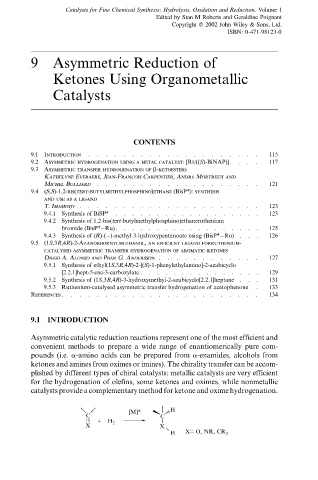
Asymmetric catalytic reduction reactions represent one of the most efficient and
convenient methods to prepare a wide range of enantiomerically pure com-
pounds (i.e. a-amino acids can be prepared from a-enamides, alcohols from
ketones and amines from oximes or imines). The chirality transfer can be accom-
plished by different types of chiral catalysts: metallic catalysts are very efficient
for the hydrogenation of olefins, some ketones and oximes, while nonmetallic
catalysts provide a complementary method for ketone and oxime hydrogenation.
H
[M]*
C C
+ H 2
X X
H X= O, NR, CR 2

