


Page 132 - Catalysts for Fine Chemical Synthesis Vol 1 - Robert & Poignant
P. 132
asymmetric reduction of ketones                 119

             Materials and equipment

             . [Ru(allyl) (COD) ], 6 mg, 0.019 mmol, 0.02 eq
                              n
                       2
             . (S)-(ÿ)-2,2 -Bis(diphenylphosphino)-1,1 -binaphthyl [(S)-BiNAP], 21 mg,
                                                 0
                        0
               0.033 mmol, 0.035 eq
             . Anhydrous acetone degassed (nitrogen) for 30 minutes, 30 mL
             . Anhydrous methanol degassed (nitrogen) for 30 minutes, 30 mL
                  As the catalyst is very sensitive to oxygen, the solvents were degassed with
               nitrogen just before use.
             . Hydrobromic acid 48 %, 1.0 mL
             . Hydrobromic acid solution 0.6 M prepared by mixing 9 mL of degassed
               methanol and 1 mL of hydrobromic acid 48 %
             . Methyl acetoacetate, 100 mL, 0.93 mmol
                  Methyl acetoacetate was dried with magnesium sulfate which was acti-
               vated at 500 8C for 2 hours cooled under vacuum and stored under nitrogen.
             . Petroleum ether, ethyl acetate, methanol
             . Silica gel 60 (0.063±0.04 mm)
             . p-Anisaldehyde

             . 50 mL Schlenk tube
             . Egg-shape magnetic stirrer bar
             . Low-pressure hydrogenation apparatus fitted with a gas burette system to
               measure the hydrogen consumed [36]
             . Rotary evaporator
             . Kugelrohr apparatus


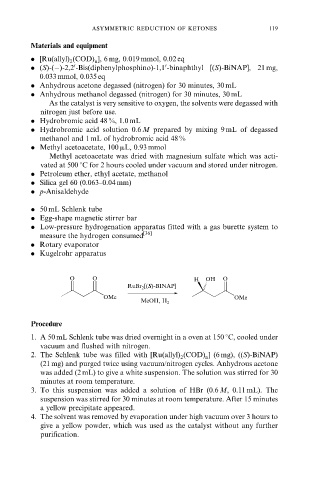
                       O     O                           H  OH   O
                                       RuBr 2 [(S)-BINAP]
                                OMe                                 OMe
                                           MeOH, H 2

             Procedure

             1. A 50 mL Schlenk tube was dried overnight in a oven at 150 8C, cooled under
               vacuum and flushed with nitrogen.
             2. The Schlenk tube was filled with [Ru(allyl) (COD) ] (6 mg), ((S)-BiNAP)
                                                            n
                                                     2
               (21 mg) and purged twice using vacuum/nitrogen cycles. Anhydrous acetone
               was added (2 mL) to give a white suspension. The solution was stirred for 30
               minutes at room temperature.
             3. To this suspension was added a solution of HBr (0.6 M, 0.11 mL). The
               suspension was stirred for 30 minutes at room temperature. After 15 minutes
               a yellow precipitate appeared.
             4. The solvent was removed by evaporation under high vacuum over 3 hours to
               give a yellow powder, which was used as the catalyst without any further
               purification.

