


Page 131 - Catalysts for Fine Chemical Synthesis Vol 1 - Robert & Poignant
P. 131
118            hydrolysis, oxidation and reduction

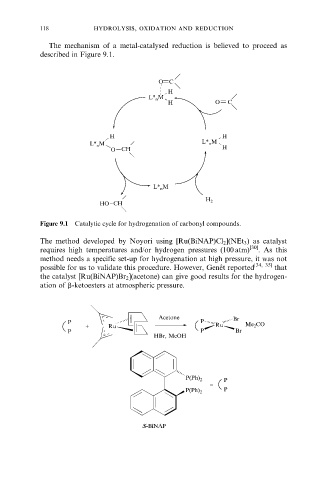
                  The mechanism of a metal-catalysed reduction is believed to proceed as
               described in Figure 9.1.


                                               O   C
                                                  H
                                             L* n M
                                                  H            O    C


                                  H                              H
                             L* n M                        L* n M
                                  O  CH                          H


                                              L* n M

                                                            H 2
                               HO CH

               Figure 9.1  Catalytic cycle for hydrogenation of carbonyl compounds.
               The method developed by Noyori using [Ru(BiNAP)Cl 2 ](NEt 3 ) as catalyst
               requires high temperatures and/or hydrogen pressures (100 atm) [30] . As this
               method needs a specific set-up for hydrogenation at high pressure, it was not
               possible for us to validate this procedure. However, Gene Ãt reported [34, 35]  that
               the catalyst [Ru(BiNAP)Br 2 ](acetone) can give good results for the hydrogen-
               ation of b-ketoesters at atmospheric pressure.


                                               Acetone              Br
                       P                                   P           Me 2 CO
                            +     Ru                           Ru
                       P                                   P        Br
                                              HBr, MeOH


                                                                 P
                                                       P(Ph) 2
                                                             =
                                                                 P
                                                       P(Ph) 2


                                           S-BiNAP

