


Page 135 - Chemical and process design handbook
P. 135
Speight_Part II_B  11/7/01  3:11 PM  Page 2.76


                  2.76                  MANUFACTURE OF CHEMICALS

                       Regenerated
                         catalyst
                                      Recycle hydrogen  Hydrogen


                                                                            Light ends

                      Regenerator  Reactor   Separator               Separator or distillation


                                                  Separator


                      Spent catalyst
                                                                  Platformate
                  Feedstock
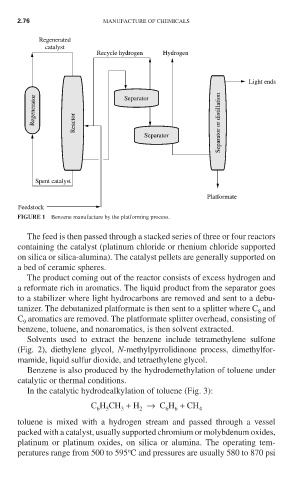
                  FIGURE 1  Benzene manufacture by the platforming process.

                    The feed is then passed through a stacked series of three or four reactors
                  containing the catalyst (platinum chloride or rhenium chloride supported
                  on silica or silica-alumina). The catalyst pellets are generally supported on
                  a bed of ceramic spheres.
                    The product coming out of the reactor consists of excess hydrogen and
                  a reformate rich in aromatics. The liquid product from the separator goes
                  to a stabilizer where light hydrocarbons are removed and sent to a debu-
                  tanizer. The debutanized platformate is then sent to a splitter where C and
                                                                              8
                  C aromatics are removed. The platformate splitter overhead, consisting of
                   9
                  benzene, toluene, and nonaromatics, is then solvent extracted.
                    Solvents used to extract the benzene include tetramethylene sulfone
                  (Fig. 2), diethylene glycol,  N-methylpyrrolidinone process, dimethylfor-
                  mamide, liquid sulfur dioxide, and tetraethylene glycol.
                    Benzene is also produced by the hydrodemethylation of toluene under
                  catalytic or thermal conditions.
                    In the catalytic hydrodealkylation of toluene (Fig. 3):
                                    C H CH + H → C H + CH
                                      6  5  3    2     6  6     4
                  toluene is mixed with a hydrogen stream and passed through a vessel
                  packed with a catalyst, usually supported chromium or molybdenum oxides,
                  platinum or platinum oxides, on silica or alumina. The operating tem-
                                              o
                  peratures range from 500 to 595 C and pressures are usually 580 to 870 psi

