


Page 197 - Chemical and process design handbook
P. 197
Speight_Part II_C  11/7/01  3:08 PM  Page 2.138


                                  CAPROLACTAM


                                                                                o
                                                 o
                  Caprolactam (melting point: 69.3 C, density: 1.02, flash point 125 C,
                               o
                  fire point: 140 C), so named because it is derived from the original name
                  for the C carboxylic acid, caproic acid, is the cyclic amide (lactam) of
                          6
                  6-aminocaproic acid.
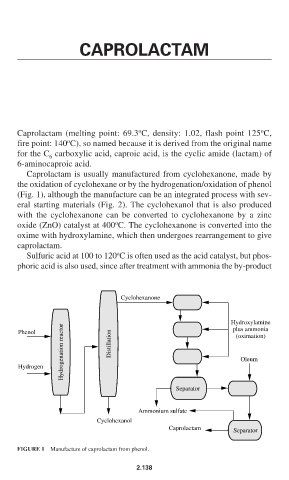
                    Caprolactam is usually manufactured from cyclohexanone, made by
                  the oxidation of cyclohexane or by the hydrogenation/oxidation of phenol
                  (Fig. 1), although the manufacture can be an integrated process with sev-
                  eral starting materials (Fig. 2). The cyclohexanol that is also produced
                  with the cyclohexanone can be converted to cyclohexanone by a zinc
                                           o
                  oxide (ZnO) catalyst at 400 C. The cyclohexanone is converted into the
                  oxime with hydroxylamine, which then undergoes rearrangement to give
                  caprolactam.
                                           o
                    Sulfuric acid at 100 to 120 C is often used as the acid catalyst, but phos-
                  phoric acid is also used, since after treatment with ammonia the by-product


                                            Cyclohexanone

                                                                        Hydroxylamine
                              Hydrogenation reactor  Distillation
                  Phenol                                                 plus ammonia
                                                                          (oximation)


                  Hydrogen                                                 Oleum

                                                          Separator


                                                 Ammonium sulfate
                                      Cyclohexanol
                                                         Caprolactam
                                                                         Separator

                  FIGURE 1  Manufacture of caprolactam from phenol.

                                                2.138

