


Page 203 - Chemical and process design handbook
P. 203
Speight_Part II_C  11/7/01  3:08 PM  Page 2.143


                                                 CARBON                          2.143
                      In the thermal black process, natural gas is cracked to carbon black and
                                           o
                    hydrogen at 1100 to 1650 C in a refractory-lined furnace in a two-cycle
                    (heating and “making,” or decomposition) operation. The reaction is
                                             CH → C + 2H
                                                4          2
                    Yields of carbon are in the range 30 to 45 percent.
                      The gas furnace process, is similar to the oil furnace process but, like
                    the thermal black process, uses natural gas as feedstock.
                      Activated carbon is manufactured from carbonaceous materials, such as
                    petroleum coke, sawdust, lignite, coal, peat, wood, charcoal, nutshells, and
                    fruit pits. Activation is a physical change wherein the surface of the carbon
                    is increased by the removal of hydrocarbons by any one of several meth-
                    ods. The most widely used methods involve treatment of the carbonaceous
                    material with oxidizing gases such as air, steam, or carbon dioxide, and the
                    carbonization of the raw material in the presence of chemical agents such
                    as zinc chloride or phosphoric acid.
                      After activated carbon has become saturated with a vapor or an adsorbed
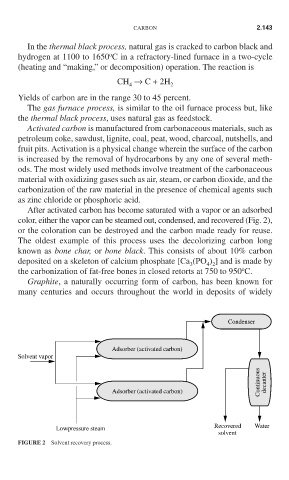
                    color, either the vapor can be steamed out, condensed, and recovered (Fig. 2),
                    or the coloration can be destroyed and the carbon made ready for reuse.
                    The oldest example of this process uses the decolorizing carbon long
                    known as bone char, or bone black. This consists of about 10% carbon
                    deposited on a skeleton of calcium phosphate [Ca (PO ) ] and is made by
                                                                    4 2
                                                                3
                                                                             o
                    the carbonization of fat-free bones in closed retorts at 750 to 950 C.
                      Graphite, a naturally occurring form of carbon, has been known for
                    many centuries and occurs throughout the world in deposits of widely

                                                                         Condenser


                                            Adsorber (activated carbon)
                    Solvent vapor
                                                                                  Continuous   decanter


                                            Adsorber (activated carbon)


                              Low-pressure steam                      Recovered   Water
                                                                       solvent
                    FIGURE 2  Solvent recovery process.

