


Page 204 - Chemical and process design handbook
P. 204
Speight_Part II_C  11/7/01  3:08 PM  Page 2.144


                  2.144                 MANUFACTURE OF CHEMICALS
                  varying purity and crystalline size and perfection. For import purposes,
                  natural graphite is classified as crystalline and amorphous The latter is not
                                                                    .
                  truly amorphous but has an imperfect lamellar microcrystalline structure.
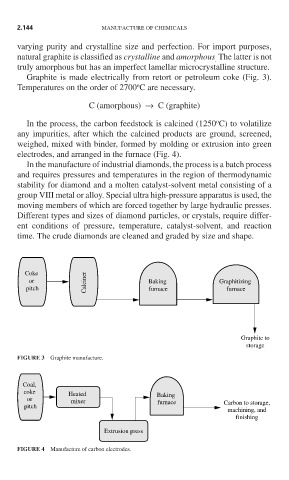
                    Graphite is made electrically from retort or petroleum coke (Fig. 3).
                                                o
                  Temperatures on the order of 2700 C are necessary.
                                    C (amorphous)  → C (graphite)

                                                                     o
                    In the process, the carbon feedstock is calcined (1250 C) to volatilize
                  any impurities, after which the calcined products are ground, screened,
                  weighed, mixed with binder, formed by molding or extrusion into green
                  electrodes, and arranged in the furnace (Fig. 4).
                    In the manufacture of industrial diamonds, the process is a batch process
                  and requires pressures and temperatures in the region of thermodynamic
                  stability for diamond and a molten catalyst-solvent metal consisting of a
                  group VIII metal or alloy. Special ultra high-pressure apparatus is used, the
                  moving members of which are forced together by large hydraulic presses.
                  Different types and sizes of diamond particles, or crystals, require differ-
                  ent conditions of pressure, temperature, catalyst-solvent, and reaction
                  time. The crude diamonds are cleaned and graded by size and shape.


                    Coke
                     or            Calciner        Baking            Graphitizing
                    pitch                           furnace            furnace


                                                                           Graphite to
                                                                            storage
                  FIGURE 3  Graphite manufacture.


                   Coal,
                    coke       Heated                 Baking
                     or
                                mixer                 furnace          Carbon to storage,
                    pitch
                                                                        machining, and
                                                                          finishing
                                        Extrusion press

                  FIGURE 4  Manufacture of carbon electrodes.

