


Page 215 - Compression Machinery for Oil and Gas
P. 215
204 SECTION    II Types of Equipment


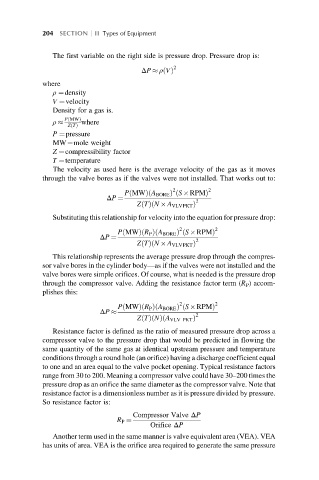
               The first variable on the right side is pressure drop. Pressure drop is:
                                                2
                                       ΔP   ρ VðÞ
            where
               ρ ¼density
               V ¼velocity
               Density for a gas is.
                  P MWÞ
                   ð
               ρ       where
                   ZTðÞ
               P ¼pressure
               MW¼mole weight
               Z ¼compressibility factor
               T ¼temperature
               The velocity as used here is the average velocity of the gas as it moves
            through the valve bores as if the valves were not installed. That works out to:
                                                2        2
                                    ð
                                         ð
                                   P MWÞ A BORE Þ S RPMÞ
                                                ð
                              ΔP ¼
                                                      2
                                          ð
                                      ZTðÞ N  A VLVPKT Þ
               Substituting this relationship for velocity into the equation for pressure drop:
                                                  2        2
                                           ð
                                       ð
                                                  ð
                                 P MWÞ R P Þ A BORE Þ S RPMÞ
                                  ð
                            ΔP ¼
                                                      2
                                      ZTðÞ N  A VLVPKT Þ
                                          ð
               This relationship represents the average pressure drop through the compres-
            sor valve bores in the cylinder body—as if the valves were not installed and the
            valve bores were simple orifices. Of course, what is needed is the pressure drop
            through the compressor valve. Adding the resistance factor term (R P ) accom-
            plishes this:
                                                  2        2
                                       ð
                                 P MWÞ R P Þ A BORE Þ S RPMÞ
                                           ð
                                  ð
                                                  ð
                            ΔP
                                                      2
                                             ð
                                      ZTðÞ NðÞ A VLV PKT Þ
               Resistance factor is defined as the ratio of measured pressure drop across a
            compressor valve to the pressure drop that would be predicted in flowing the
            same quantity of the same gas at identical upstream pressure and temperature
            conditions through a round hole (an orifice) having a discharge coefficient equal
            to one and an area equal to the valve pocket opening. Typical resistance factors
            range from 30 to 200. Meaning a compressor valve could have 30–200 times the
            pressure drop as an orifice the same diameter as the compressor valve. Note that
            resistance factor is a dimensionless number as it is pressure divided by pressure.
            So resistance factor is:
                                     Compressor Valve ΔP
                                 R P ¼
                                          Orifice ΔP
               Another term used in the same manner is valve equivalent area (VEA). VEA
            has units of area. VEA is the orifice area required to generate the same pressure

