


Page 476 - Compression Machinery for Oil and Gas
P. 476
456 SECTION    III Applications


            blank-off flanges. Typical gases used in the test include air, nitrogen, carbon
            dioxide, and some noble gases like argon and helium.
               During a mechanical run test, the compressor is brought up to maximum
            continuous speed until operating conditions are settled. API 617 [4] requires
            that the compressor shall be run continuously for at least 4h during the test.
            Vibrations and lube oil parameters are closely measured, observed, and
            recorded at various data points along different operating speeds.
               A performance test is conducted to verify the aerodynamic performance of
            the compressor. It is usually performed in a closed loop, using nitrogen, CO 2 ,
            methane, or other gases. ASME PTC 10 [1] or ISO 5389 [5] define the require-
            ments for this type of tests. Depending on the specific requirements, a test can
            also be performed in an open cycle, using ambient air.
               Performance testing conducted in accordance with ASME PTC-10 [1] usu-
            ally requires a closed loop. A type 1 test is the most straightforward way of test-
            ing. The test gas is similar to specified gas used for the compressor design. In a
            type 2 test, inert gases like nitrogen, carbon dioxide, and nitrogen-helium mix-
            tures, and different types of Freon can be used. The test conditions have to be
            defined such that aerodynamic similarity between test conditions and specified
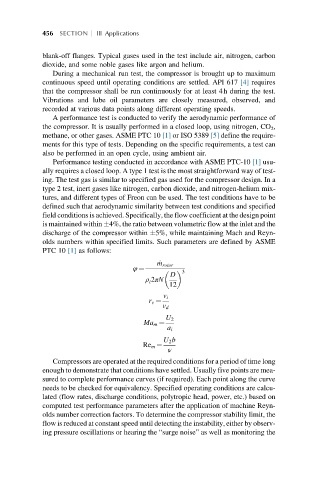
            field conditions is achieved. Specifically, the flow coefficient at the design point
            is maintained within  4%, the ratio between volumetric flow at the inlet and the
            discharge of the compressor within  5%, while maintaining Mach and Reyn-
            olds numbers within specified limits. Such parameters are defined by ASME
            PTC 10 [1] as follows:
                                            _ m rotor
                                     φ ¼
                                                   3
                                               D
                                        ρ 2πN
                                         i
                                               12
                                             v i
                                         r v ¼
                                             v d
                                              U 2
                                        Ma m ¼
                                              a i
                                             U 2 b
                                        Re m ¼
                                              ν
               Compressors are operated at the required conditions for a period of time long
            enough to demonstrate that conditions have settled. Usually five points are mea-
            sured to complete performance curves (if required). Each point along the curve
            needs to be checked for equivalency. Specified operating conditions are calcu-
            lated (flow rates, discharge conditions, polytropic head, power, etc.) based on
            computed test performance parameters after the application of machine Reyn-
            olds number correction factors. To determine the compressor stability limit, the
            flow is reduced at constant speed until detecting the instability, either by observ-
            ing pressure oscillations or hearing the “surge noise” as well as monitoring the

